Oids – FTL/Xavagus Prime Software - 1990-2002 - First time playing?: Yes!
 This is my repentance for all of the call centre robots I stapled to death in Harry the Handsome Executive.
I didn't actually know of Oids until it was suggested to me by my Neocities mutual, P7uen. Originally Oids was released on the Atari ST in 1987, but a few years later it made its way to my website’s ballpark with a retail Macintosh port in 1990, and that inspired a collaboration between us. That physical media distribution of Oids for the likes of System 6 and 7 is unfortunately incompatible with my more modern G4 Mac OS 9 machines, but fortunately one of the original devs of that Mac port went on to develop and release an official version 2.0 of Oids in 2002, distributed via shareware. In addition to 2.0 being compatible with Mac OS 9, it also introduces new levels and a full soundtrack. The game is mostly identical however, right down to the UI, graphics, controls, original levels and so on. P7 has meanwhile been playing and reviewing the Atari ST version of Oids in tandem with me, which I also contributed to in the form of a Q&A. Give it a read here. Read the other reviews on gravity shooters while you’re on the site too, they’re great.
 So, the hell is an Oids? Aside from sounding really silly if you say it out loud with extra emphasis on the ‘Oi’, the Oids are android slaves built with full sapience and even souls according to the manual. They're used for physical labour by the aliens known as the Biocretes, who leave them to rust and fall to pieces slaving away in factories until they're falling apart, at which point they are melted alive to make even more Oids. Wow, the Biocretes are as evil as they are stupid. You could have solved this by just not giving them sapience, but you just had to flex, didn't you? It's up to you now to attack the Biocretes-controlled galaxies, destroy their factories, rescue the Oids and take them to an Oid colony where they can live free.
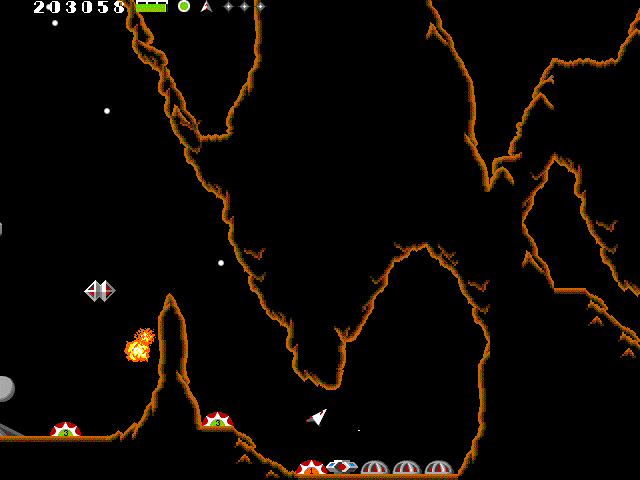
Oids is a gravity shooter in the mold of Gravitar and Thrust. You'll be rotating your ship left and right and then use the thrusters to propel your ship in the direction it's currently facing. The difference here compared to the likes of Asteroids or Maelstrom is gravity. Each level is set on a planet with a gravitational pull, so if you let go of the thrusters, you'll gradually float down to the surface. Your ship can also shoot in order to destroy attacking enemies and bases as well as Oid prisons. In addition to your pea shooter, you also have a limited supply of Nova Bombs that are slower, but do very heavy damage if you line your shot up right. Finally, you also have a shield that can be activated instantaneously with a held keystroke. This makes your one-HP wonder of a ship invulnerable to enemy attacks and crashing into level terrain, which also kills you. The more you use the shield, the more your shield’s energy gets drained until it's no longer usable, however you can refuel your shield by syphoning your fuel supply.
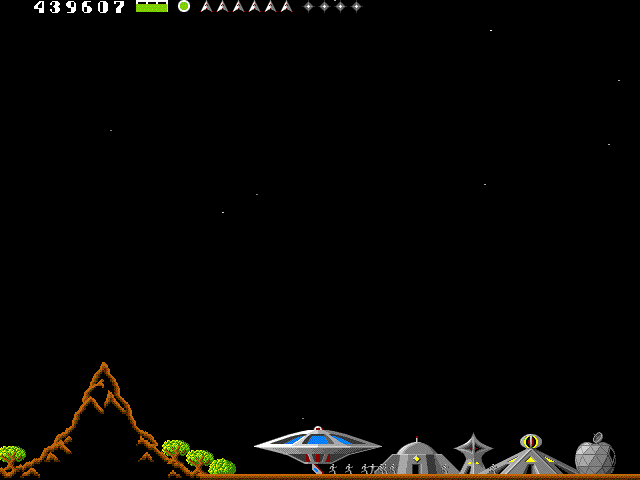
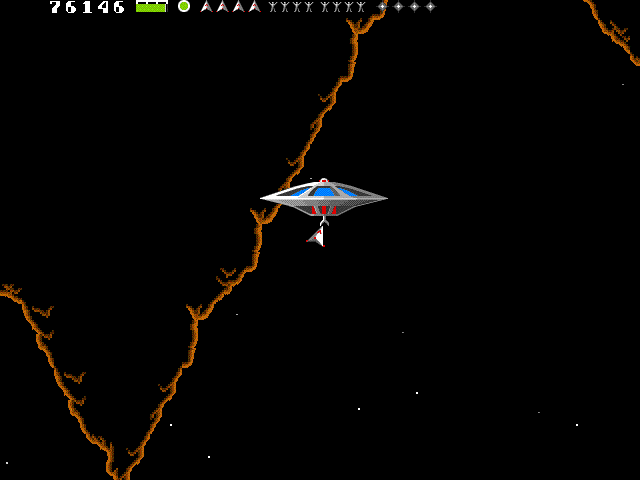 Your objective is to explore the levels for Oid prisons, break the Oids free and then land next to them Lunar Lander style in order to load them into your ship. You can carry eight Oids on your ship at a single time. Once you've hit the maximum ship capacity, you'll need to take the Oids back to the mother ship to unload before you can pick up any more Oids. You do have to be very careful also because Oids are very prone to dying horribly. A single stray shot will kill them instantly, so you need to be careful with your shots when blasting open the Oid prisons. Furthermore, the fire from your ship’s thrusters can also kill the Oids. Heck, even the shield kills the Oids instantly, so you better make sure you've destroyed all attacking enemies before you land to pick up an Oid, or else you might get shot at while you're waiting for the Oid to get onboard and have no choice but to put your shield up and sacrifice the Oid. A level is completed once all Oids have been either rescued or killed in action, after which you're carried off to the next planet to continue your rescue mission.
The base game is divided up into six galaxies which are essentially level sets, with anywhere from three to eight levels each. You'll choose what galaxy you want to play in the main menu and will then start at the first planet of that galaxy. You have limited lives and a game over results in you losing all progress in the galaxy and having to start again from the first planet. Extra lives are however obtained any time you deliver eight Oids to the mother ship.
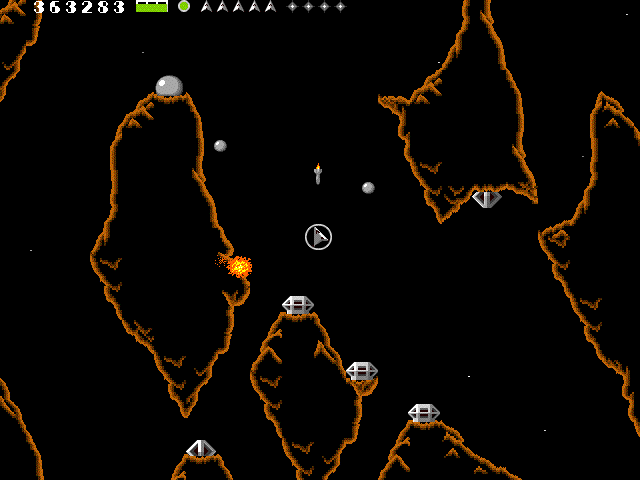
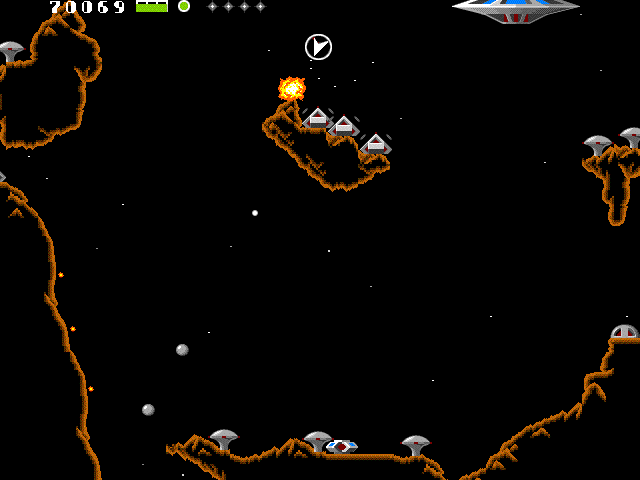 A concept like this is more or less going to live or die by the quality of the physics, and fortunately Oids’ physics feel great. They achieve an appropriate level of floatiness suited for the game’s low-gravity environments, but the inertia behind your movements convey the weight of the ship well too. Thrusting in one direction will have you build up a ton of speed for covering wide open and empty spaces with ease, but with gentle taps you are also capable of the delicate and precise movements required to thread your ship through tight caverns without crashing and burning. Notable also is the way that your fired projectiles are also affected by your ship’s inertia. For instance, if your ship is facing up while drifting to the left, any fired shots will be aimed up but also drift slightly to the left just like your ship. This can be used to your advantage by allowing you to shoot around corners.
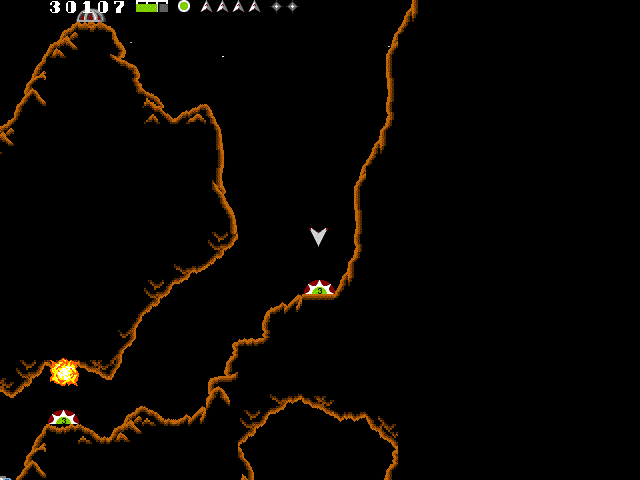
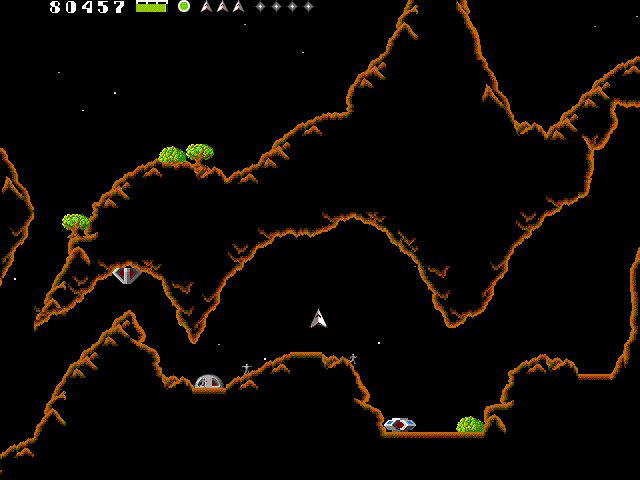
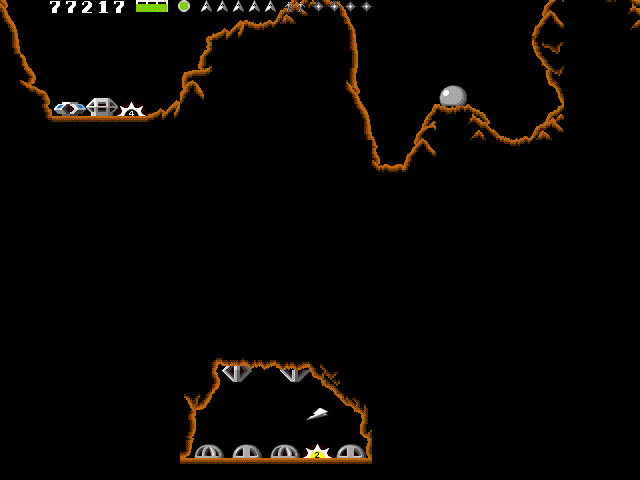
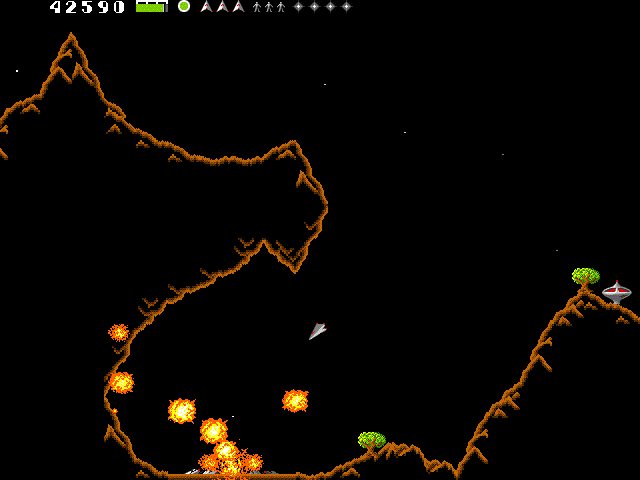
Most levels further play with the physics engine with the introduction of two Biocrete structures that influence gravity, those being the mushroom-shaped Repulsers (present in the screenshot below) and the diamond-shaped Gravity Bases (present in the screenshot to the right). Both of these structures have magnetic fields that push away and pull in your ship respectively. You'll likely want to destroy these as quickly as possible. The game often places groups of them together in a way that results in your ship being slingshot around the level wildly.
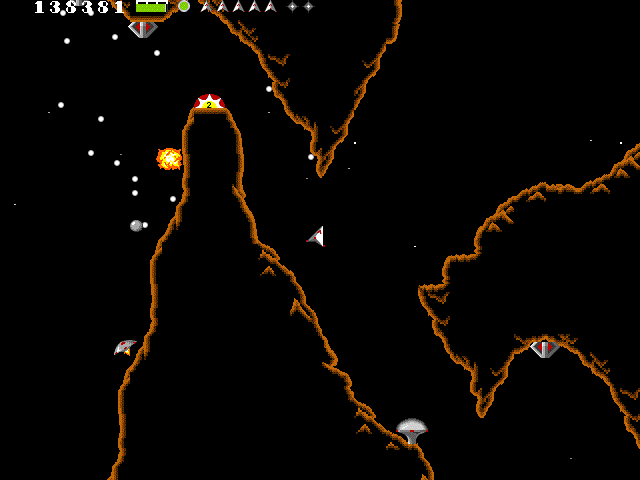
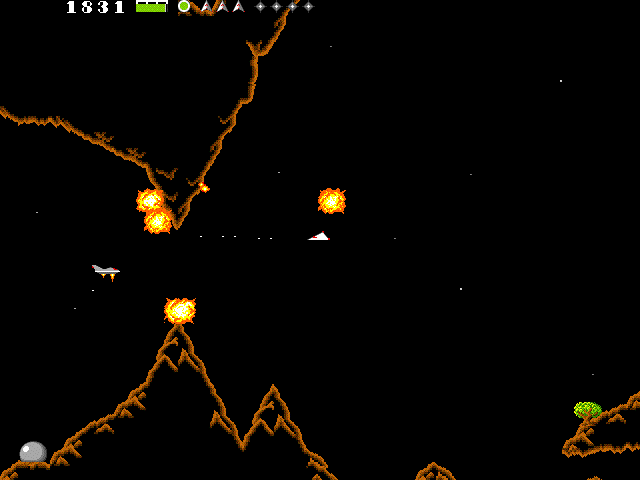
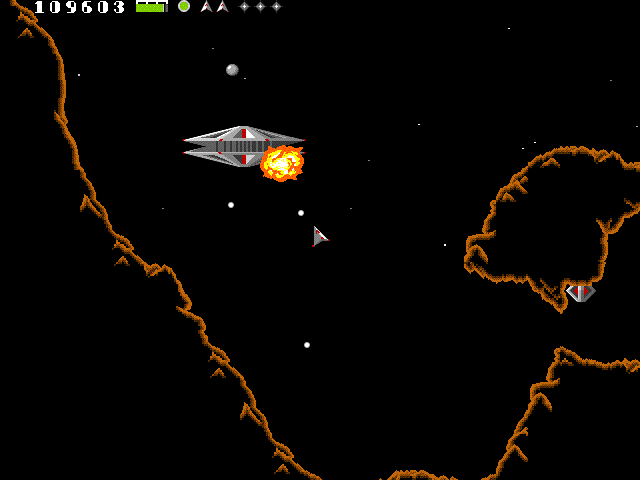 Other Biocrete structures will hinder you with much more direct attacks, such as turrets, mines and enemy spawners. Most of these are destroyed in a single shot, though sometimes lining that shot up can be difficult while also trying to swerve through projectiles. The large home bases are particularly high priority targets due to them spawning in aggressive mobile enemies. Unlike the other structures however, the home bases are tanky and often protected by an even tankier force field, so rapid fire and ideally a Nova Bomb are recommended. If you spend too long on a planet as well, a Biocrete mother ship will spawn in to hunt you down and shoot at you, which looks intimidating for sure, but is actually not too big a threat unless you're low on fuel. They're a big and easy target to hit and they're prone to crashing into terrain which deals them damage as well.
NThe lack of restraint in how many hazards the game throws at you is probably my biggest complaint. Oids is more than happy to fill the screen with dozens of enemy spawners protected by tanky force fields, magnetic fields and bullets everywhere, until eventually everything happening on screen is so incomprehensibly chaotic that you're basically forced to simply use the shields and tank the hits, as the heavy physics prevent you from quickly weaving through such relentless attacks. Notably, the Atari ST version seems to run quite a bit slower than the Mac 2.0 version, so the onslaught may be more manageable on Oids’ original platform.
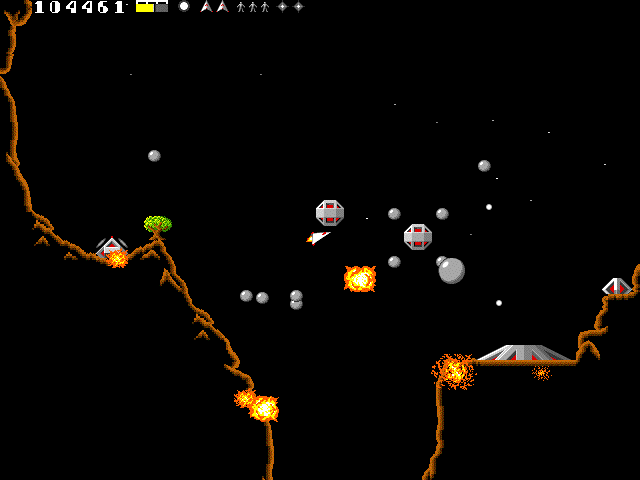
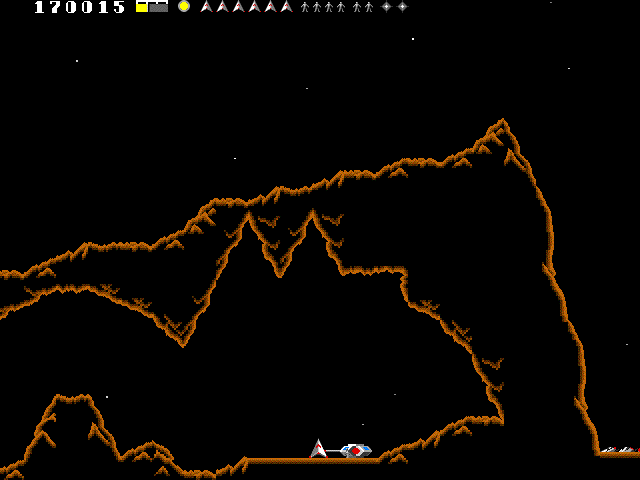 As a result of this, Oids becomes a bit of a resource management game. You'll burn through your ship’s fuel supply pretty quickly due to your shield usage, so you'll need to refuel frequently one of two ways. The first way to refuel is to collect eight Oids and return to the mother ship. The second way is to use the Biocretes’ fuel stations, which will automatically fuel your ship if you land it right next to the station. This in itself is a delicate task. Getting close enough to the station to be in range for refueling without just crashing into the fuel tank and dying in a fiery explosion is tough.
On the topic of Biocrete structures you can use to your advantage, I love how the teleporters are implemented. These numbered domes can not be destroyed, but if you fly into them, you will be instantly teleported to another dome on the map with the same number on it, carrying your inertia with you. Not only does this open up shortcuts to traverse levels quicker with, as well as granting you access to secluded caves, but it's also useful in combat as well. If you shoot a teleporter, that shot will also be teleported to the other side, allowing you to safely take out enemies from afar behind the teleporter. Often the most hectic and seemingly unfair combat encounters can be made much easier by creative teleporter usage and it's always satisfying to figure out the less direct methods of combat that the game is clearly designed with the expectation of you exploiting.
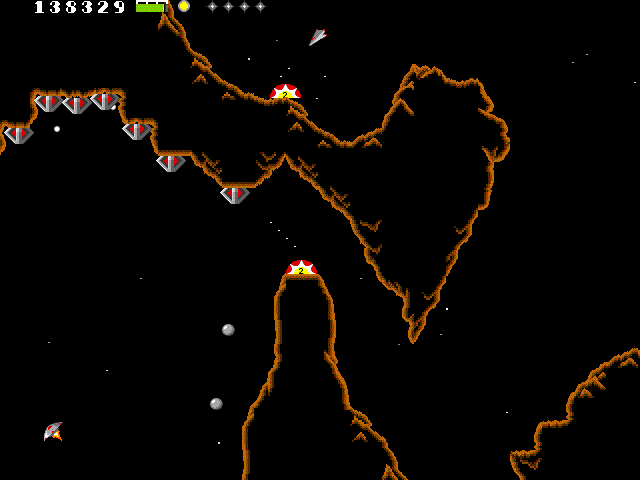
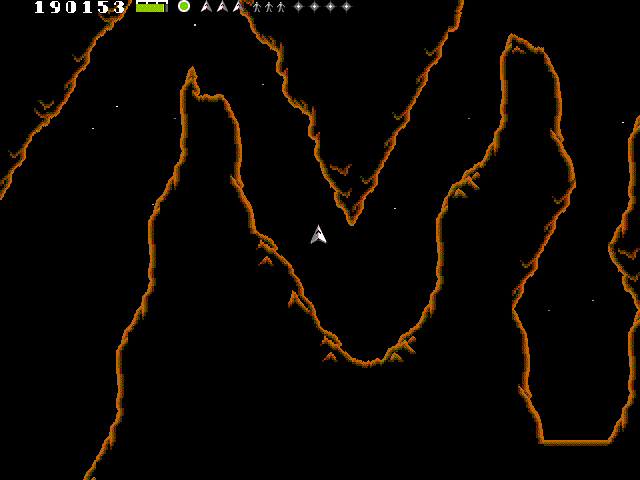
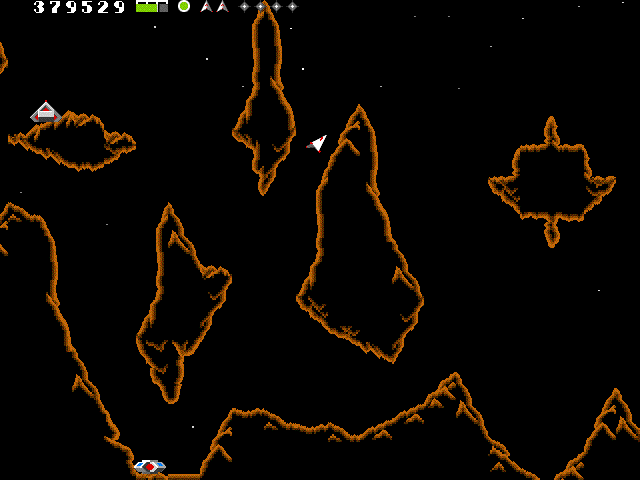 The levels are quite large and open-ended. They wrap around horizontally, so if you keep flying to the right for long enough you will eventually wrap around to the left side of the map. Vertically, there's a lot of open air at the higher points of the map, but there's also plenty of claustrophobic caverns to venture into under the surface of the planet. There's a lot to explore, with many levels also having optional side-paths that are more dangerous but offer more scoring opportunities. Furthermore, the objective of rescuing all the Oids gives you freedom in the order you rescue said Oids in, presenting more opportunities for alternative routes through each level.
Generally, I have a rule in place that I'll only review games I actually manage to beat. Full disclosure here; I didn't manage to beat every galaxy in Oids. I ended up walled by the two hardest galaxies; Gravdromeda and Trianguloid. These are the longest galaxies in the game, with seven to eight planets each, and they're utterly relentless, loaded to the brim with every hazard imaginable, often even having you start the level by spawning in the middle of a mess of magnetic fields, thus having you immediately struggling for control the second the game starts. Oids is quite the slow, tense kind of game due to the delicate movements required for traversing its levels, and doing eight levels of such delicate manoeuvres interspersed with hectic bullet hell shootouts is enough to put me at risk of a heart attack. Even on the easier galaxy with only six planets, my body was tense and my nerves were shot the entire time I spent on the final planet of that galaxy, knowing that all progress could be easily lost in an instant.
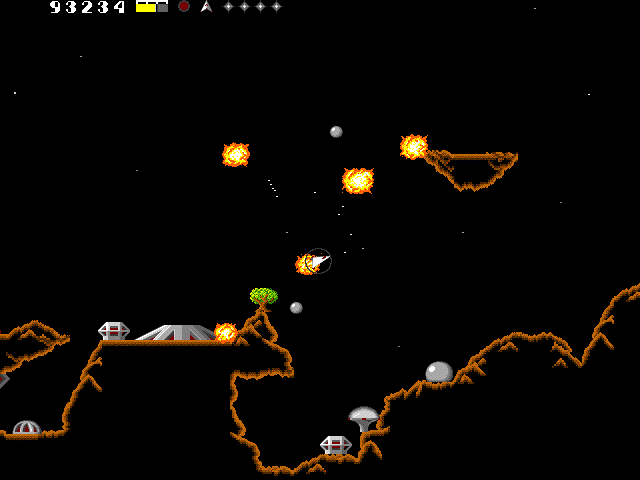
I don't feel too bad however, as I believe I've generally seen all of what Oids has to offer. I doubt completing the last two galaxies will give a different ending than the one you get for beating the other four galaxies for starters, but also the game more or less has shown off all of its mechanics and ideas by the second galaxy. You've got the same enemies and structures throughout all set in similar rocky caverns all using the same colour palette. The game does however find new and interesting ways to playfully implement those basic mechanics throughout (especially the teleporters) that prevents the game from being overly repetitive.
If you want more Oids however, you are in luck. Oids 2.0 already includes an additional six galaxies, but that's not all. As a result of all versions of the game shipping with a level editor, there's also user-made galaxies out there too. Namely, there's a pack of Oids levels called Expanding Galaxies which includes 45 more galaxies, each with multiple levels. The content here is more or less infinite, as long as you don't tire of the same base mechanics.
 Tense and stressful as it may be, Oids is also a fun arcade thrill that is satisfying to master. The game works well as an arcade style score attack game as well. I wouldn't call the game excessively unfair either, even if the skill ceiling is high. You ultimately do have the tools to even the odds with your Nova Bombs and shields and enough opportunities to refuel your ship. Oids is well balanced and thought out overall, with a ton of longevity for those who get really into it.
To close things off, I sent P7 a few questions to compare our experiences with Oids a bit and get a little more insight into the Atari ST original. Here’s what I asked alongside P7’s answers.
MSX: Something I noticed when playing the Mac version is that when you take a hit and are in the exploding animation, there's a brief few mercy frames at the very start of that explosion animation where you can press the shield button and still save your ship. I spent much of my playthrough trying to figure out if that was an intentional feature or an oversight. Does that occur in the ST version?
P7: I had to go back and test it because I didn't notice that at all! I'm always impressed by how much you pick up on very detailed mechanics just like in your Bubble Bobble review that blew my mind. The answer is either no it doesn't have that (or I'm not quick enough to perform it).
 MSX: Any kinds of levels in particular that stood out to you? I personally enjoyed the teleporter-focused levels.
P7: I really enjoyed the tight spaces and maneuvering challenges more than the bullet hell, although I did enjoy the basic combat. Maybe that's my recent gravity game fixation talking. The teleporters were really clever, much more than I expected from this game.
MSX: In terms of control, how heavy are the physics/inertia compared to other gravity shooters you have looked at so far?
P7: I really didn't like it at first, it's much more floaty than other games I've played and so it felt like you have less control. After a while I realised the lower gravity means you have much more leeway to just blast around and have fun, so I really ended up enjoying that aspect. I think it really worked for a game that is more about fun and combat, compared to Thrust where the entire level is usually 'try to slowly traverse this short, straight corridor without losing your dignity'.
MSX: The Atari ST version seems to run a bit slower than the Mac version from the footage I could find online. Without any comparison, did the speed feel right to you, or did it feel a bit off like it may be running slower than intended? By contrast, I felt like the Mac version may have been running slightly too fast, though not enough to break the game.
P7: It really does feel slow on the Atari, I ended up finding a modded version that is supposedly faster, but either I didn't notice the difference or I wasn't getting it to work correctly. I've seen videos of the Mac version and it looks so much smoother. That said it doesn't feel too laggy once you're used to it. It's a real negative for me but I don't hold it against them for being old and slow (I sympathise!).
Be sure to check out P7's review of the Atari ST version here if you haven't already. Thanks again for the collab!
- Page written by MSX_POCKY, 4th December 2025