Maelstrom – Ambrosia Software - 1992 - First time playing?: Yes!
 Previously on Overclockworked, we looked at Apeiron, an early shareware Mac arcade game by Ambrosia Software that in spite of being a simple Centipede clone actually ended up being one of the most memorable things I've played on Mac OS thanks to the sheer amount of humour and character worked into every aspect of it. So, what happens when Ambrosia adapts another classic Atari game, like Asteroids? In spite of the order I've reviewed these games in, Maelstrom actually came out first, and was in fact the first game Ambrosia ever released. They started strong too; Maelstrom was one of the most successful Mac games of its time, managing to hold its own against the likes of Myst and SimCity 2000 in its reception, according to the official FAQ document included with the game. Maelstrom could be dismissed as a cheap Asteroids clone, yet it carries a surprising amount of historical significance. The financial and critical success of Maelstrom helped to set a standard for the future of shareware distribution on Mac OS, as well as playing a key role in influencing much of Ambrosia’s later releases for the platform
There’s a story here. You know what the story is? It’s the exact same story as in Asteroids. You are a patrolman who screws up and gets lost in an asteroid belt. The Maelstrom in particular; a notoriously dangerous asteroid belt on the border of Alpha Centauri. If it's not the asteroids that will kill you, it's the Shenobi (sic) alien spacecraft on the other side of the maelstrom that will do you in instead. That, or maybe you'll just get consumed by a vortex, that's also a possibility. You're not getting out of the Maelstrom of course. In the end, death comes to us all. Story is as important here as it is in Asteroids.
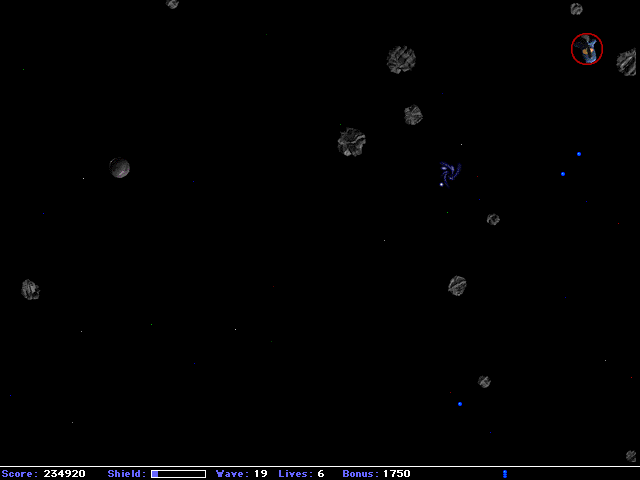 Get into gameplay and, yep, it's Asteroids. Rotate your ship clockwise and counterclockwise, use the thrust to accelerate in the direction your ship is pointing. Shoot asteroids to break them apart into smaller rocks, then shoot those smaller rocks until nothing is left but space dust. Levels are cleared once all asteroids are destroyed. Sometimes a UFO will show up and start shooting at you as well. Getting shot is bad. Crashing into rocks is also bad. As self explanatory as you’d want from a classic arcade game.
In spite of that, Maelstrom is quite a different game in a lot of subtle ways that end up radically changing how it feels to play, mainly in regard to the physics. Movement in Asteroids is slow and heavy, and if you are not using the thrust, your ship gradually decelerates on its own. In Maelstrom meanwhile, movement is much more twitchy and snappy due to the thrust having much faster acceleration, and the only way to slow down is to turn 180 degrees and thrust in the opposite direction. Notably, this is very akin to the controls later used in Ambrosia Software’s Escape Velocity. It's interesting seeing that the combat in that game actually drew inspiration more from Maelstrom in particular than it did from Asteroids as I initially thought, and makes me wonder if there's any shared code between the games.
Additionally, the hyperspace teleport mechanic from Asteroids isn’t present in Maelstrom, instead opting for the shield mechanic from Asteroids’ official sequel, Asteroids Deluxe. Holding down the shield key causes a forcefield to surround your ship. While this forcefield is up you are invincible, but keeping it up also gradually drains your shield gauge. Quickly tapping and releasing the shield key with good timing will take out incoming asteroids without draining your shields too heavily, but it is of course safer to keep it held down earlier and for a longer duration, adding a risk vs reward kind of resource management that I personally prefer to the random chance of the hyperspace mechanic.
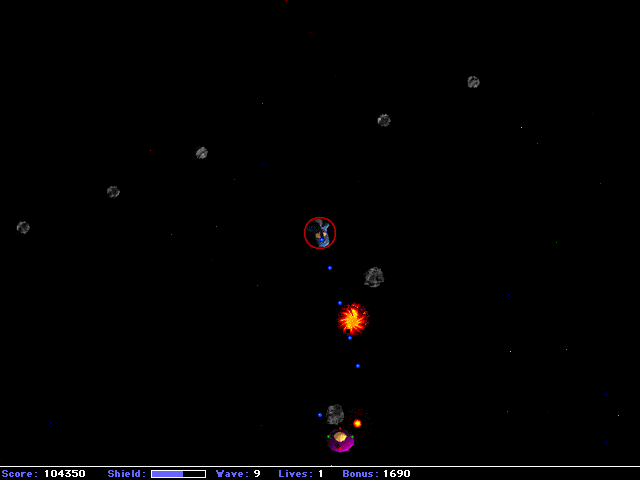
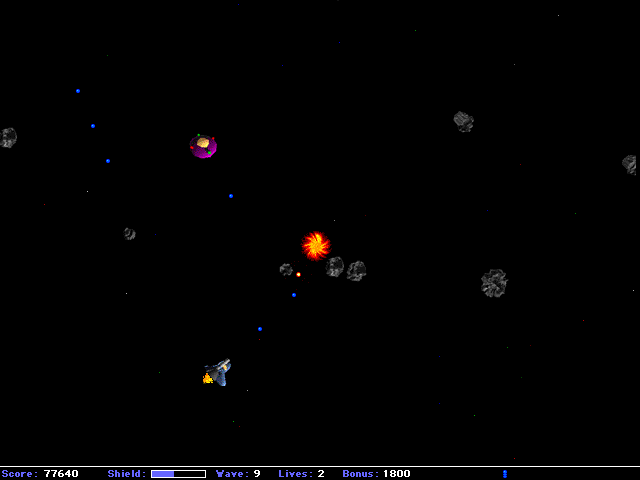
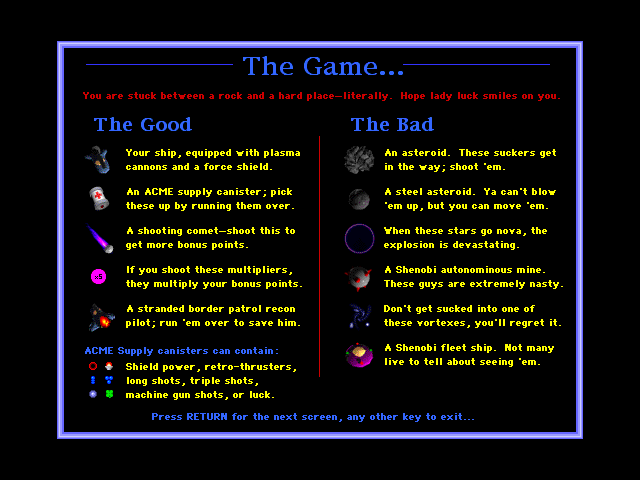
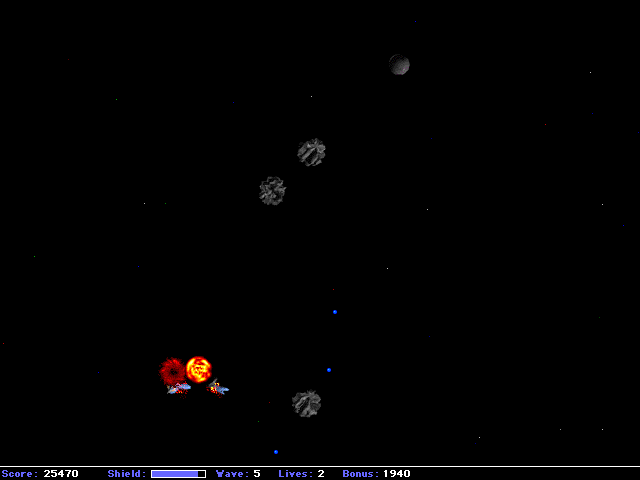
The rest of the new content in Maelstrom consists of additions rather than changes. On top of the base Asteroids gameplay, you also have new hazards, power ups and random events. In terms of hazards, alongside the Shenobi UFOs which behave more or less the same as the Asteroids UFOs, there are also Shenobi mines; explosive drones that home in on the player’s spacecraft, often inaccurately orbiting around it but also capable of hitting it directly if you're careless. They're quite tanky, taking six shots before they're destroyed, so their inaccuracy helps prevent them from being completely unmanageable. The real threat are the vortexes, gravitational wells that pull your ship into an instant kill. I was really struggling with these at first, they felt completely unfair due to how suddenly they spawned in and how difficult the gravitational pull is to fight against. They never stopped being a serious threat, but they got a lot easier once I realised you can just shoot them out of existence… somehow. I figured that wouldn't work, I'm not sure how you shoot a hole into a hole that makes the hole stop existing. Either way, they're nowhere near as tanky as the mines, so if you act quickly they can be dispatched before they cause you issues… as long as they don't just immediately pull you into an asteroid, anyway. And also as long as the game doesn't just spawn in seven of the bloody things all at once.
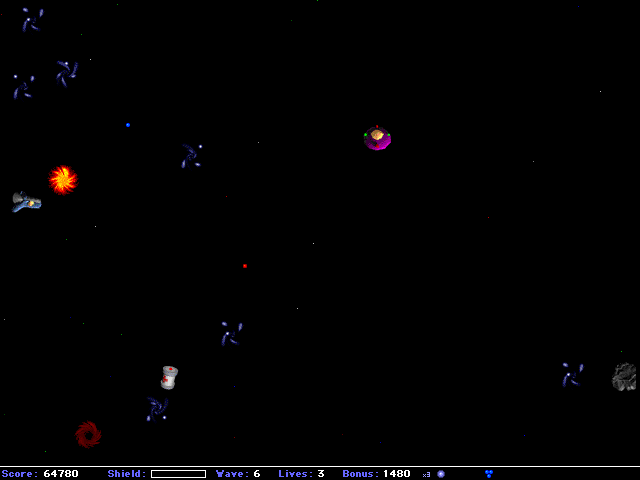
 Yeah, screw you too, game.
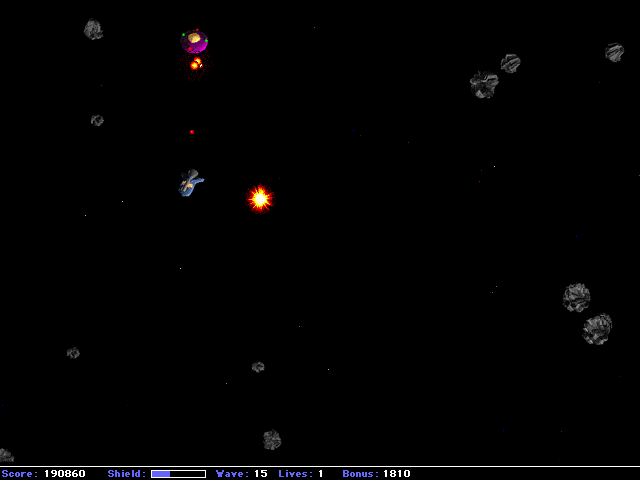
The final hazard is a little unusual, that being the supernova. This collapsing star causes a space earthquake, (don't think too hard about it,) making the screen shake and all asteroids either break apart or be destroyed entirely depending on their size. It's disorienting, but can be potentially helpful as well, thanks to clearing out the fast moving smaller asteroids that may be swarming the screen. Don't want a space earthquake? Then you can, uh, just shoot the supernova before it explodes. This somehow defuses it and erases it from existence. Honestly, this space ship's unassuming laser gun gets more and more terrifying the longer I think about it. How powerful is this gun to be able to erase all consuming black holes and giant explosions from existence? And yet in spite of that, the Shenobi mines are still able to take six shots of these reality-deleting blasts. I understand why the Shenobi are considered a threat now.
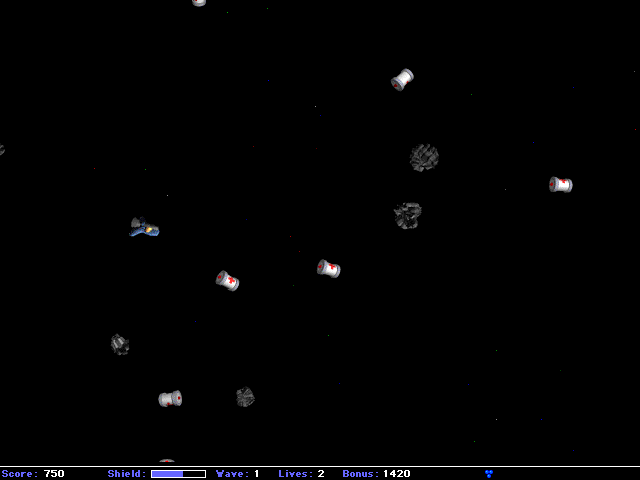 In terms of power-ups, most of them are earned by collecting the red crossed capsules that are somewhat misleadingly not used for healing. Collecting one of these capsules gives you a power-up at random. The two best power-ups by far are the spread shot and the machine gun rapidfire, making it much easier to perform crowd control on the asteroid chunks as the larger rocks break apart. Right behind those two power-ups is the retro-thruster, which results in the game physics being adjusted to be more akin to Asteroids, with automatic deceleration, which helps make keeping your ship under control a little easier. The long range power-up that lets your shots travel further sounds good, but in actuality it’s often more of a hindrance as there’s a limit to how many bullets can be on screen at a single time, and since the long range shots inherently stay on screen for longer, that means you’re left open for a much longer time once you’ve hit the sprite limit and have to wait for all of your missed shots to fizzle out before you can fire again. Still not as lame as the luck powerup however. When you have the luck powerup you have, according to the FAQ, a one-in-three chance of keeping your power-ups or not losing a life when you are killed. In all the time I spent playing this game, I saw it activate twice, while every other time it did absolutely nothing. I have no idea if I’m just supremely unlucky or if that one-in-three claim is a flat-out lie.
Power-up capsules also have a chance to refill your shield gauge, temporarily freeze all hazards on screen, or deal damage to everything on screen when collected. That’s eight possible outcomes total that could happen any time you collect a capsule. This is kind of an issue, as what you get from a capsule is entirely random and the capsules themselves are very rare, although on very rare occasions the game may spawn in multiple at once. There’s generally a chance for one of them to spawn in on a single level, but more often than not they won’t appear at all. Furthermore, the capsules are moving targets that require some finesse to catch due to working with the thruster physics, and if you take too long to collect them they’ll explode and you miss out on that power-up entirely. Shooting them also makes them explode. The second I see a capsule, it’s an immediate panicky scramble to try and grab it since I’m not likely to get another such chance for several more levels, and also often throws me in danger of crashing into an asteroid in my attempt to collect it. So, with the rarity, short window of opportunity and fragility of these capsules, finally managing to get one and being rewarded with the useless lucky clover power-up suuucks. One-ups behave in a similar way, they are similarly rare and just as fragile and evasive as the capsules.
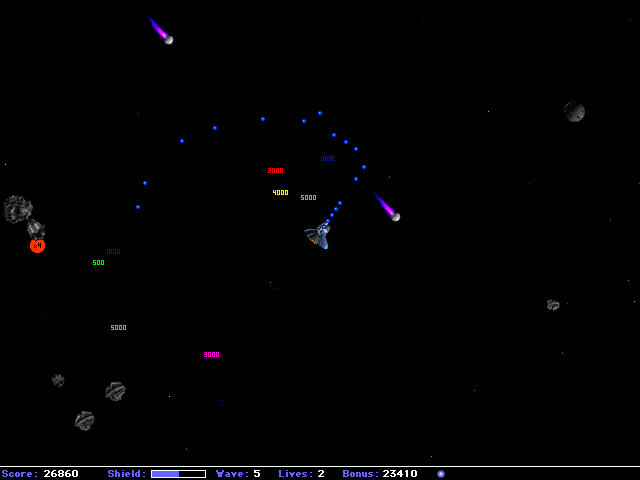
 The remaining items are used for scoring. Shooting comets and multiplier targets can randomly spawn in during the first 30 seconds of a level. Shooting a comet adds a random amount of points to your bonus points, those being points that are awarded to you upon completing a level, but gradually tick down in value the longer you spend in the level. Multipliers meanwhile do what you’d expect and multiply that bonus value by the amount displayed on the target. These are integral to getting good scores, so it’s a little annoying that they’re also pretty random in terms of when they decide to spawn is, as well as if they’ll even give you a decent payout. If you’re really lucky, you might get to witness a meteor shower, and if you’re even more lucky and also get a multiplier on that same level, watch your score skyrocket to absurdity.
The polished presentation further helped Maelstrom stand out at the time in spite of its simplicity. It's easy to take for granted now, but the graphics on display here were pretty eye-catching for the time. Coming out in 1992, this was at a time before games such as Myst or Donkey Kong Country had popularised pre-rendered graphics. Maelstrom’s pseudo 3D ships and asteroids are smoothly animated, and thanks to the fact that they ultimately are just 2D sprites using a 3D model as a base, the system requirements are low and Maelstrom runs on basically any Mac capable of displaying 256 colours. I can't help but wonder if Maelstrom was at all inspired by the Atari 7800 port of Asteroids, which also featured pseudo 3D sprites.
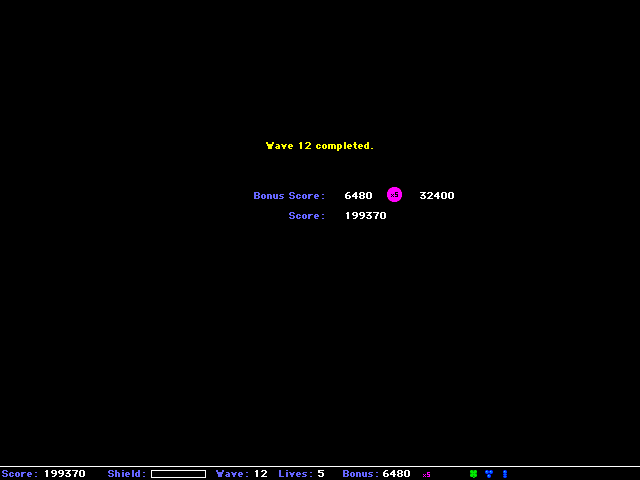
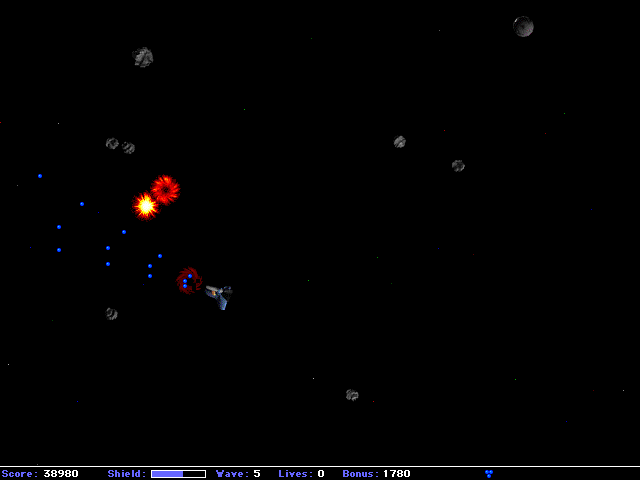 As is expected from Ambrosia, the sound effects are quite silly. You've once again got the sound of a woman orgasming when you get a bonus multiplier, but this is the third damn Mac arcade game I've played for this site now that features an erotic moan, so I'm not even surprised anymore. On top of that, you've also got Ren calling you an “eeediot” if you accidentally shoot a power-up capsule, and while I was never a Ren & Stimpy fan I still find that at least a bit amusing. At least, until a Shenobi UFO comes in and shoots the power-up itself. Shut up Ren, that one wasn't my fault. My favourite however is the “hot damn!” voice clip that plays whenever you get over 10,000 in bonus points at the end of a level, that never stops being satisfying. The sound design isn't quite on the level of utterly unhinged chaos that Apeiron is, but it remains memorable all the same.
Honestly, I feel like I should have saved Apeiron for last when it comes to reviewing Ambrosia’s arcade clones, because that game is genuinely funny and oozing with charm that is really hard to compare to. The way that every single enemy in the game has a detailed bio explaining their personality and how they're all friends that just specifically think it would be really funny to gang up on you and eat your soul is hilarious and adds so much more playful character to what would have otherwise been a mundane clone. To be clear however, Maelstrom meanwhile is by no means dry and has funny elements as well. One of my favourite small details in Maelstrom I didn't even notice at first is how goofy your ship’s design is. The giant gun barrel awkwardly super glued to the top of it in particular gets a smirk out of me. Maelstrom doesn’t however contain a character that is explicitly stated by the game to be mentally unwell and in desperate need of therapy, so Apeiron has the win there.
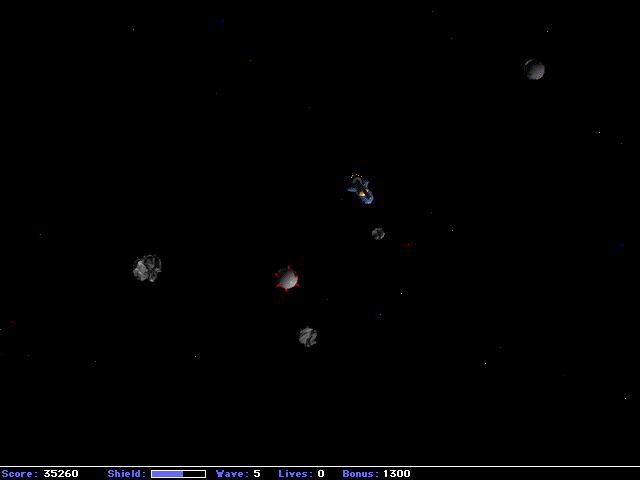
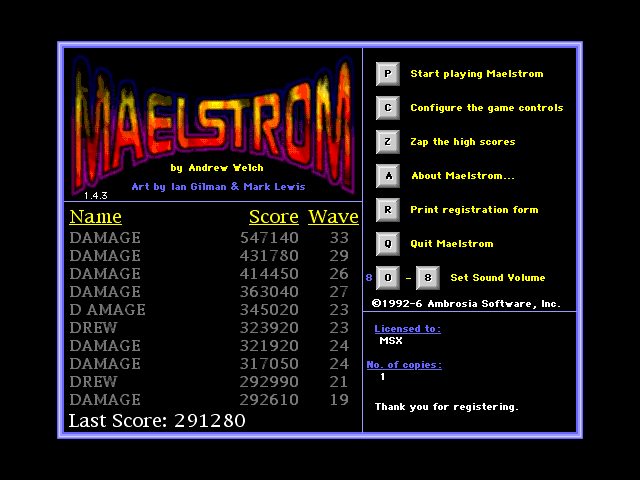
Now, when I do a review of an endless arcade game like this, I like to set myself some sort of goal; a milestone to achieve before finalising my review of it. In Apeiron for instance it was to reach level 100, and in Crystal Quest it was to reach level 41. In the case of Maelstrom? I just wanted to make it into the high score board. Even if it's just tenth place I'd consider that a win. I know that sounds like a low bar, but astonishingly I have not been able to achieve it. I don't think I'm awful at Maelstrom or anything. I can make it up to around level 20-25 or so when I’m playing at my best, but the default high scores brought to us courtesy of Drew Damage are so ridiculously high that I'm convinced they must be dev high scores. Extra lives aren't easily obtained either, with you only getting another life every 50,000 points, or if you rescue one of your shipwrecked comrades (before they detonate or are shot) who have a chance of spawning in as a rare random event that you can't exactly rely on. Even if you do have a bunch of stockpiled lives, those can be drained in the span of a couple of levels due to how fragile your ship is and all of the crazy random events like vortexes and mines that can screw you over. It got exhausting, and after I got this close to getting beating Drew’s tenth best high score, only to still fail? I tried again and again for hours on end but I think that score was my limit. None of my following attempts were able to exceed it, and I just had to give Drew the W on this one. The stress isn’t worth it, games are meant to be fun.
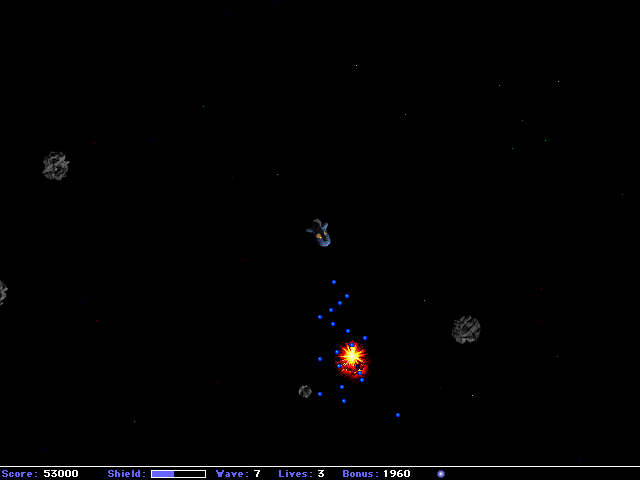 At the same time though? It's kind of exciting. Don't get me wrong, it is stressful and takes a ton of focus on the later levels, but that tension adds a thrill to it. It's a much faster paced and more aggressive game than Asteroids all around, and I think I actually might prefer it to the source material as a result. The randomness does result in some unfairness to be sure, but isn't severe enough to kill the game outright, while also adding a bit of a thrill as I’m always left wondering what items or power-ups or random events will show up next round if I just keep pushing forward a little further, as they often can be massive game changers. I wouldn't call Maelstrom required playing unless you're interested in the historical significance, I was surprised by how much I did get into it, and can recommend it to anyone who is after something of a remix of Asteroids that manages to be familiar yet different at the same time. Considering it's free now as well, it’s available to any curious readers at zero cost. Maelstrom was actually made open source, so there’s now ports for the game available on Windows, modern Mac OS and Linux. Here’s the link to download the Mac and Windows versions of the port. If you’re on a Debian-based Linux distro, your software manager likely has Maelstrom already if you search for it. If not, the Windows version works fine in Wine. The physics in this port felt a little off to me from what I played, as did some of the animations and general speed and pace of the game. It’s not a bad recreation by any means however, and I’m likely only noticing the subtle differences due to having just spent the last two days playing nothing but Maelstrom obsessively. Yeah, the game addicted me.
Oh, by the way.
Sike.

Screw you, Drew Damage!
If any of you can beat Drew Damage’s top score, please email me personally to say how much I suck at Maelstrom and how it’s actually easy.
- Page written by MSX_POCKY, 12th November 2025