Dark Castle (Colour) – Delta Tao Software (Original 1986 B&W version by Jonathan Gay) - 1994 - First time playing?: Yes!
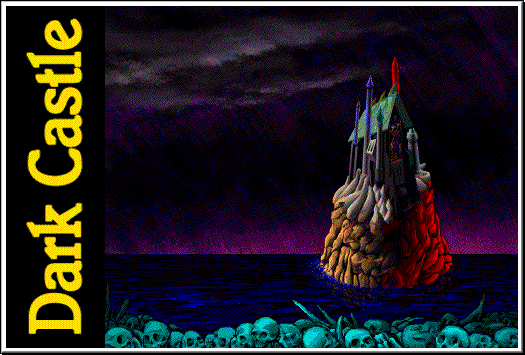
 A side effect of how forgotten and buried a lot of Mac gaming culture has become is the revilement of Dark Castle. Today it's mostly known as one of the worst SEGA Mega Drive games ever made, thanks to exposure through the likes of the Angry Video Game Nerd and other such internet reviewers. So, it might surprise you if you do some searching for Dark Castle’s reception and discover that it was actually a critical darling and beloved classic… on Macintosh. Not on Mega Drive, not on DOS, and certainly not on CD-i. Dark Castle’s ports are awful across the board.
Part of the draw to the Mac version of Dark Castle is the surprisingly ahead of its time control scheme, where you can use WASD to move, the space bar to jump, and the mouse to aim and throw projectiles. Yes, all the way back in 1986, Dark Castle over here had already implemented the standard first-person shooter control scheme. Funnily enough, John Romero was actually involved in the Apple IIGS port of Dark Castle, so there's a good chance this may have influenced him, what with the manual for Doom encouraging combining mouse and keyboard controls even when the default control scheme was made to be keyboard-only friendly. This is part of why the controls are so bad in the Mega Drive version of Dark Castle, as they had to substitute the mouse aiming with awkwardly using the d-pad to slowly rotate your protagonist's arm.
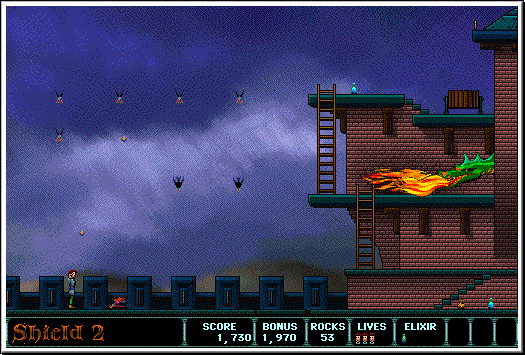
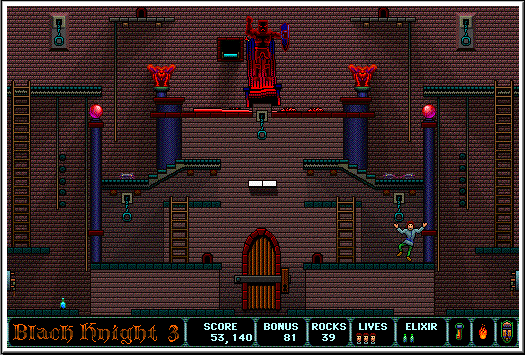
 Now, you may have already noticed that these screenshots are in colour, which doesn't match up with me stating the Mac version was released in 1986, way before 8-bit colour was supported on Mac OS. What we are looking at here is actually an updated remake of Dark Castle, released in 1994 by Delta Tao Software, a classic Mac developer also notable for shareware strategy classics Strategic Conquest 3.0 and Spaceward Ho. This version is compatible with much later iterations of Mac OS, all the way to Mac OS 9.2.2. However, the graphics won't display properly if you're using the wrong Mac OS ROM file in your computer’s system folder. If that file is a higher version than 8.7, then Dark Castle won't work for… some reason. In addition to the improved compatibility, the graphics have also been redone in 8-bit colour, a new easier difficulty level has been added and there's even a save feature. It's also kind of busted the difficulty in another way that we'll get into later.
So, you are Prince Duncan. Think Dirk the Daring in terms of being a bit of a bumbling idiot that dies real easily, except instead of having a practical weapon like a sword, Duncan instead brought a sack of rocks with him like he's Charlie Brown on Halloween. The Black Knight, the local menace, is up at the top of the dark castle quaffing an infinite supply of beer endlessly, and it's up to your hapless arse to topple him off his throne. You do this with clunky controls and jerky animations and low frame rate and awful hit detection and annoying sound effects and…
Okay, yeah. Even when playing the superior version, I do not like Dark Castle.
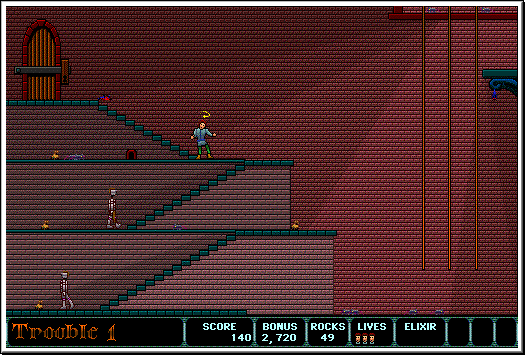 The controls have the honour of being ‘better than the Mega Drive port’, but that's really not saying much. Rock throwing being controlled by the mouse does make a huge difference for the better. I had very little issues hitting what I needed to thanks to how quick and easy it is to adjust your aim simply by moving the mouse up and down. It's still a little odd by today's standards as instead of a crosshair indicating where you'll throw your rocks you instead use the position that Duncan holds his arm in to tell what angle he'll throw the rocks at, and if you want to aim behind you you'll need to turn around manually with the keyboard. Once you adapt though, it's no problem at all.
The bigger problem is, well, everything else. Movement feels akin to a Game & Watch platformer like Donkey Kong Jr due to the way that Duncan awkwardly snaps to predetermined spaces with each step. That's not necessarily a bad thing in itself, other games such as Oddworld: Abe’s Oddysee made it work, but the pace of Dark Castle is more fast-paced and action-oriented than Oddworld’s puzzle focus. You can't throw rocks when running either, requiring you to come to a dead halt before you can start taking aim. Running off the edge of a platform won't have Duncan simply drop off, but instead run across thin air a couple of feet, freeze in mid-air, realise that he’s standing on nothing and then fall down. The obvious intent is a Looney Tunes reference, but this impacts gameplay as no matter how lightly you tap the movement keys to try and just step forward a little bit, Duncan will always automatically sprint an extra few steps more than you told him to in order to get in position for that animation to unfold, screwing you over if there's something directly underneath you that you specifically wanted to drop down to. The lengthiness of the animation can also result in your timing getting thrown off when trying to land on moving platforms.
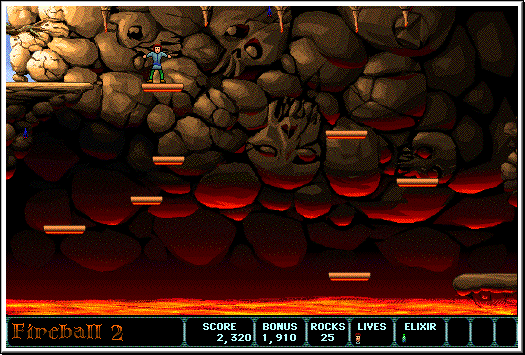
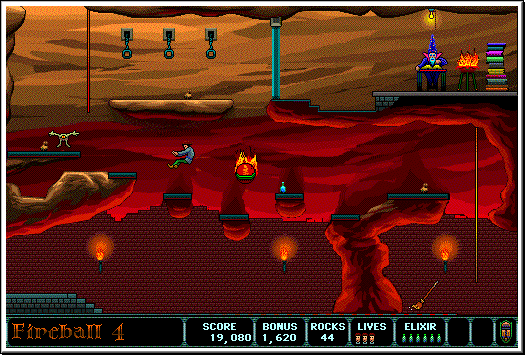 As for jumping, Duncan has two jumps. Jump at a standstill and Duncan will take a hop forward. Jump while running and Duncan will do a long jump with less height and more crashing into enemies that his jump is too low to fly over. The jump is jittery and feels stilted. You can't change direction or control your trajectory mid-air. Furthermore, if your jump arc has you fall further than the height you jumped from, Duncan will lose all forward momentum, go “WOAH” and start falling straight down. Usually this results in him being dizzy and staggered when he hits the ground, which leaves him vulnerable for a few seconds while he stumbles around in circles, possibly stumbling off the platform you wanted to land on. Yes, there are also points where you're required to jump to platforms below you, resulting in that lengthy staggered animation every single time you jump to another platform. Platforming is jerky and stilted in a way that makes landing even the simplest jumps a nightmare.
I think a huge part of the issue is just how little flow there is to anything in Dark Castle. Movement is fast and jumping is faster, with the choppy framerate also making these actions feel faster due to Duncan awkwardly snapping to fixed positions on the screen in a single frame, but many of these basic actions are interrupted by slapstick cartoon animations that cause Duncan to come briefly to a dead halt in the middle of basic actions like jumping. Duncan is also a massive klutz, tripping over small steps and even unconscious bodies of enemies, which results in him falling flat on his face, standing back up, and then when he's finally upright again, doing that staggered animation he does when he falls from a great height, further delaying how long it takes before you can control him again, all the while a single attack from an enemy can kill you.
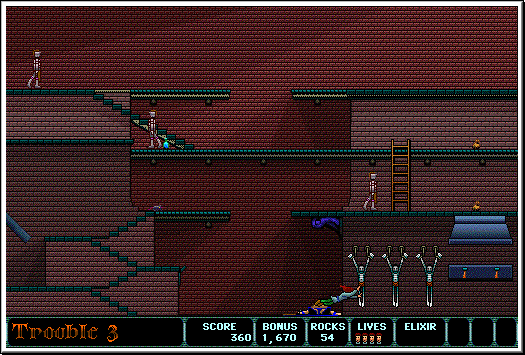
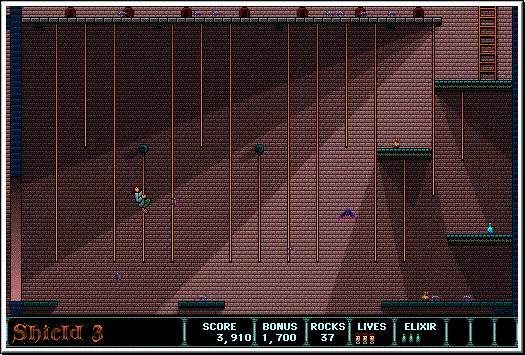 As I critique Dark Castle, I do have to remind myself regularly that the game came out in 1986, and much of the praise the game received from critics is emblematic of that. I might today personally find the animation jerky and choppy, but critics at the time praised Dark Castle for its fluid animation. I was baffled by this for a while, but I think I get it. When Dark Castle came out, nearly every platformer just had a single static jump sprite for your player character. By contrast, Dark Castle has a frame-by-frame jump animation of Duncan crouching, springing up, stretching his legs out and then landing. Prince of Persia wouldn't come out until three years later (and it took even longer to get a Mac port), and I think that Dark Castle’s animation and somewhat more realistic physics could be seen as a precursor to what Prince of Persia would later achieve with in my opinion far more success. To use an analogy, Prince of Persia controls like a swinging pendulum, smooth and flowing with satisfying weight and physics that can be honestly mesmerising to watch. Dark Castle meanwhile controls like the seconds hand on a clock, suddenly jutting to one of its 60 predetermined positions with each tick, except for the times where the cogs in the clock get jammed and the hand gets stuck.
Perhaps the variety in levels was also a draw. Dark Castle's 14 levels may be short single-screen affairs, but there's a clear conscious effort to make sure you're doing something different in each of those few levels, with different enemy types, different puzzles and different objects to interact with. I could compare it to Lode Runner, another single screen action puzzle platformer that was out on Mac at the time Dark Castle came out, and had a significantly more impressive 150 levels, but ultimately Lode Runner is a much more repetitive and simple game with only a single enemy type and nothing but stone bricks and ladders and ropes as far as the eyes can see. In Dark Castle meanwhile, one level will have you pour water over a dragon to extinguish their flames, another level involves taking a flail to duel a torturer in the dungeons, followed by a puzzle where you have to figure out which of two keys is booby trapped by an environmental clue, and another level has a jumping puzzle where some of the platforms are fake and you can temporarily confirm which platforms are real by pulling a level that flashes the ledges you won't fall through if you jump on them. The levels also have some quite lush pixel art for the time, both in the black and white version and the colour version, that further makes every level memorably visually distinct.
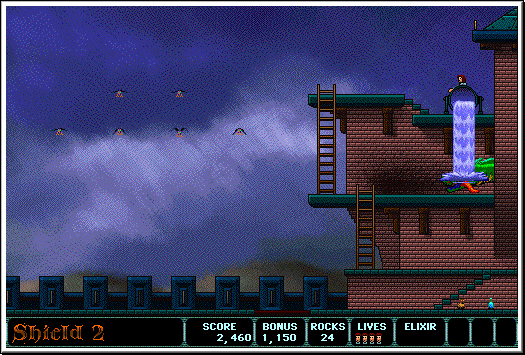
 The game’s mechanics also evolve as you progress through the game and get new abilities, somewhat akin to a Metroidvania. There's two permanent upgrades to get; the shield and the fireball magic. Once you have the shield you can make yourself invulnerable to all enemy attacks for a few seconds while stationary, and the fireball magic makes your basic stone-throwing attack stronger. You technically have access to the finale at the start of the game, but you won't make it far without those upgrades. Metroid came out the same year, so the concept was still new.
When you start the game, Duncan is placed in the entrance hall, from which you have four options. From left to right, there's the trouble door, the fireball door, the Black Knight door and the shield door. Fireball and shield lead to their respective power-ups, while the Black Knight door leads to the final boss. This leaves the trouble door unaccounted for. This leads to the Trouble Dungeon, a phrase that has lived rent-free in my head ever since I saw Mega Man Sprite Game where it's used to refer to the Tower of Druaga, which now has me questioning if the Trouble Dungeon was a Dark Castle reference this entire time. There is no reward for completing the Trouble Dungeon except for the potential for grinding resources. Getting the shield should be your first priority, so let's go there and-
Oh, we're in the Trouble Dungeon now.
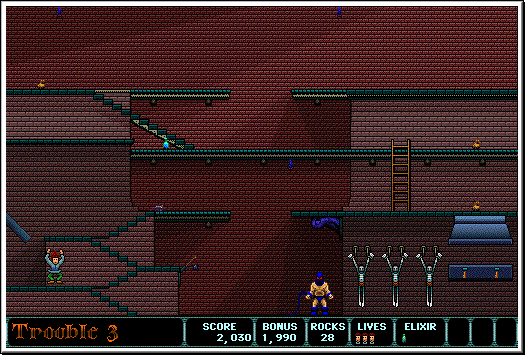
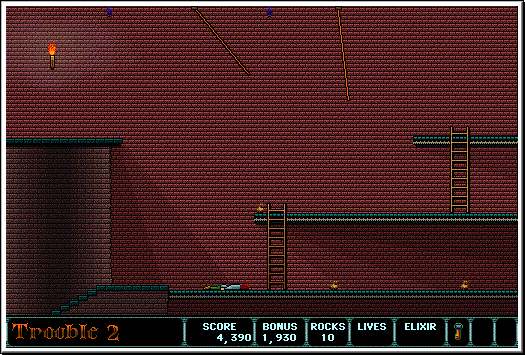
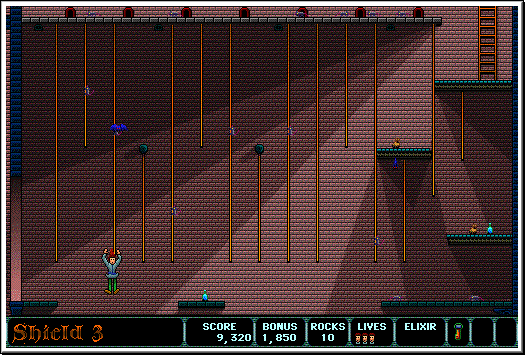 So, many of the levels in this game start with Duncan standing on a trapdoor, which will open a second after starting the level and drop you into the Trouble Dungeon. You need to move immediately or else you can say goodbye to progress. Falling into a bottomless pit also sends you to the Trouble Dungeon, so if you have a choice between dying or falling into a pit, dying is usually the best option due to you losing less progress and wasting less time. Out of the 11 levels you're required to play through in order to beat the game, six of them have either trapdoors or a bottomless pit. For more than half of the game, this is a constant threat.
The later levels also introduce the gargoyle, the most annoying enemy in the game by far. The gargoyle will squawk three times off-screen to let you know it's about to attack, and then it swoops in and charges directly at you. You can not avoid the gargoyle, as it's faster than you and tracks you perfectly, so you have to hit it with a fireball to kill it. If it grabs you however, it doesn't kill you, but instead picks you up, carries you to a bottomless pit and then throws you into it, which means, yep, yet again, Trouble Dungeon. Every single level in the black knight route has infinitely spawning gargoyles and they're awful.
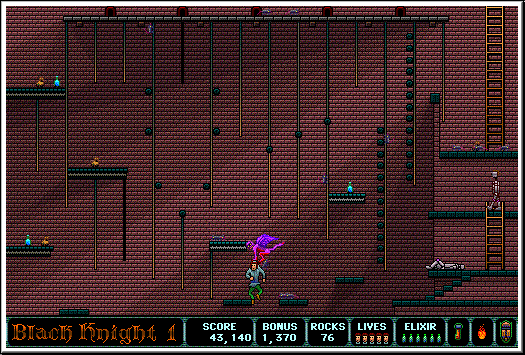
Now, the intended way out of the Trouble Dungeon’s three levels is for you to fight the torturer and steal the key behind him, followed by climbing up and platforming through the three screens to get back to the entrance hall. So, a bit of a time waster frankly. The colour remake however allows you to instantly return to the entrance hall at any time by pressing the command key + Q key at the same time, even if you're in the Trouble Dungeon which is intentionally designed to keep you stuck and delay progress.
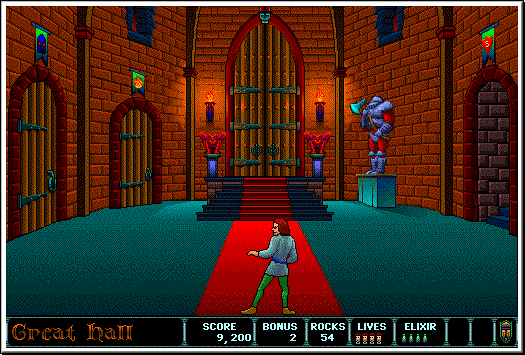
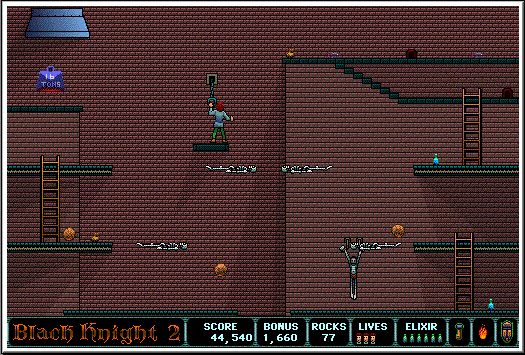 The thing with Dark Castle is that the game requires some level of trial and error and experimentation to figure out how to solve the levels. The levels are filled with enemies and hazards that generally result in there being very little down time and few safe spots, with even the starting spot frequently being dangerous if you don't immediately move. Not only that, but enemies infinitely respawn and defending yourself burns through your limited ammo. Several levels also get harder the longer you stay in them for, as that results in more enemies and hazards spawning in. There is one specific solution to solve every level and if you veer off of that solution or even just idle for too long you will either die or end up back in the Trouble Dungeon, which further delays how long it takes before you get back to the level you died on to get one chance to do it right without falling into a pit or trapdoor. Often you'll die so quickly in levels that it will take several attempts before you can even process what you're looking at. You could pause to get a better view of the level, but the pause text also obscures the screen which makes that difficult.
It's not just the Trouble Dungeon that delays your progress however, as there's also resource management. Duncan can only defend himself if he has rocks to throw. He can hold up to 89 rocks at once, and he can get more by picking up sacks of rocks placed throughout the levels. This is also clunky, since picking something up in Dark Castle requires coming to a dead halt exactly on the item you want to collect and then pressing the action key to bend down and pick it up. Not something you always have a chance to safely do with swarms of infinitely spawning enemies. If you run out of rocks, in most levels you're utterly screwed. If the rock sacks you need to defend yourself are guarded by monsters you can't defend yourself against, you have a problem. Furthermore, there's the elixirs. The rats and bats of Dark Castle are apparently infected with the plague, which is enough for Duncan to instantly keel over and die on contact with them. However, if you have an elixir, instead of dying when one of those two enemies touch you, you'll instead just consume one elixir. There doesn't seem to be a cap on how many elixirs you can't hold at once. The HUD only counts up to six elixirs, but you can get more and the game behind the HUD will still keep track of how many you've got. Later levels spawn rats rapidly enough that it's unfeasible to be able to dodge all of them with the clunky controls, especially when platforming is involved, so you need to have elixirs stocked up, and running out of elixirs at the black knight levels is likely to be a death sentence. So, what do you do if you need more of these resources? Grind. Replay easier levels to get more. Blegh.
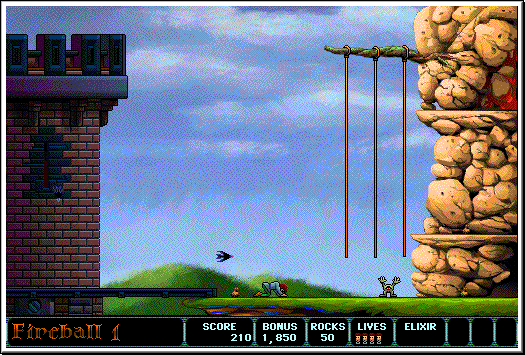
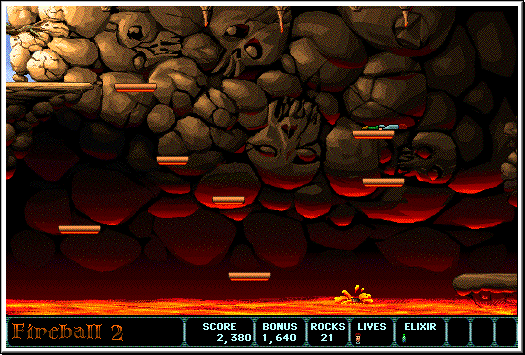
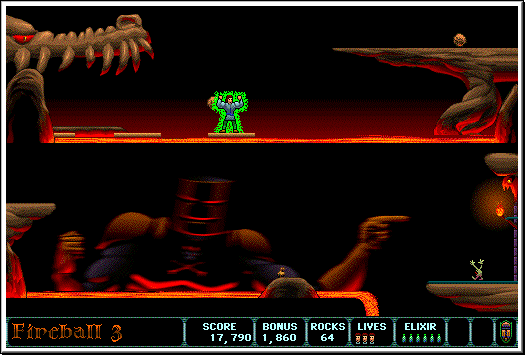 More than anything, I think the issue with Dark Castle is that even if you master the controls, know every level inside out, never get sent to the Trouble Dungeon and manage your resources well, it's just… still not fun. For instance, let's look at the fireball route. The first level here is whatever, just fight the birds, don't trip over the small step, climb up the ropes and exit the level. It's too short and simple to muster up any enthusiasm for. The second level meanwhile is tedious, dull and horribly unfun. You start at the top of the level, and you have to make your way to the bottom by jumping down onto lower moving platforms above lava. This means that every single jump in this level is followed up by Duncan entering his staggered animation due to the fall damage mechanic. Also, the level contains two bats and falling stalactites. The bats are fine, they don't respawn and are easily killed. The stalactites meanwhile fall after a set amount of time has passed. Since every platform in this level is moving left and right and Duncan is staggered for a few seconds after every single jump, this means that while you're staggered, the platform you're on could move under a stalactite as it falls and kill you while you're unable to move. So, the safest way to do this level? Just sit and wait until the stalactites fall. Boring.
Following that there's another thoroughly underwhelming level where you ride a moving platform over lava. Just sit there and wait, use the shield if boulders fall near you, and then jump to the exit. Also boring. Following that is the only somewhat interesting level of the lot, having you climb up a small platforming section while an eye shoots projectiles at you, which you can briefly stun by throwing rocks. It's not much, but it's something unlike the first and third levels and it's not frustratingly tedious like the second. And with that, you've already beaten over a third of the game, just across those four short and simple levels that were only challenging because of the controls. Dark Castle levels are frustrating when you don't know how to play them and keep dying, but once you get the hang of them they're utterly dull due to how little they have going on.
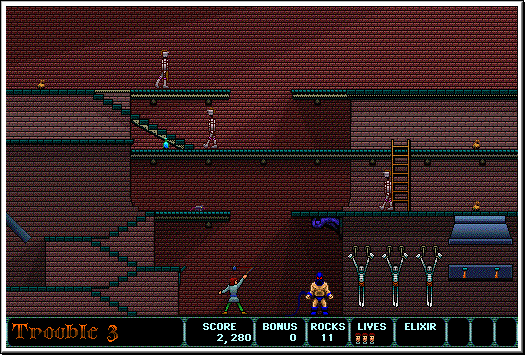 Honestly, it's kind of bizarre that some of the more interesting levels are relegated to the optional Trouble Dungeon. The one in the torture chamber is actually pretty cool, what with fighting the torturer with the mace and the puzzle involving figuring out what key is safe to take, and on top of that there's also a platforming sequence above the torturer that prevent the level from just being a single set piece and nothing else. If the rest of the levels were that involved, the game might have been a bit more interesting to me.
As it stands, Dark Castle feels bad to control, isn't satisfying to get good at, is extremely short and simple and uses punishing difficulty to extend its playtime. I respect the art direction, creative setpieces, mouse aiming and its place in Mac gaming history, but I get very little enjoyment out of it at all. Console and arcade games of the time trounced Dark Castle as far as I'm concerned. Give me Wonder Boy or Bubble Bobble over this any day. Of course, those options weren't available on Mac at the time, leaving Dark Castle without competition on the platform. As for the colour version, it has stiffer competition due to the wider selection of games available by the time it came out. Glider Pro also came out the same year as Dark Castle’s colour remake and is a far more satisfying and rewarding game. I also already mentioned Prince of Persia and Lode Runner, two series with multiple excellent games on Mac. Specifically after a platformer with a WASD + mouse aiming control setup? It came out a couple of years later than the colour version of Dark Castle, but consider trying Abuse. The game that is called Abuse, not the act of abusing. Monkey Shines also came out in 1996 alongside Abuse and is a much simpler but also more enjoyable game. My point is, by 1998, you had some great options available that I consider far more replayable and fulfilling.
But it feels bad also, to be honest. I had heard Dark Castle on Mac was a beloved classic and the poor reputation it earned was purely down to the console ports being awful and doing the original masterpiece a disservice. I was hoping to bring light to an unsung gem tarnished by time not due to the game being bad, but through its name being besmirched by the notoriety of shoddy conversions on more widely discussed platforms. So, walking away from this game feeling that Dark Castle was always awful honestly leaves a bad taste in my mouth. I was hoping to cheer on an underdog and all, but I couldn't lie and say I felt the game was anything but terrible. But hey, if you love Dark Castle and see something in it that I don't? All the power to you. Honestly, if you feel that I missed something here, I'd be happy to hear. Flick me an email or a message on Neocities. Whether I enjoyed it or not, Dark Castle was clearly an important and influential piece of Mac gaming history, and it deserves respect for that.
Now, before I go, a final footnote. A frankly amazing excerpt from the Dark Castle Colour manual.
Based as hell. Mad respect, Delta Tao.
- Page written by MSX_POCKY, 23rd July 2025