Menace – DMA Design/Psygnosis - 1988 - First time playing?: Yes!
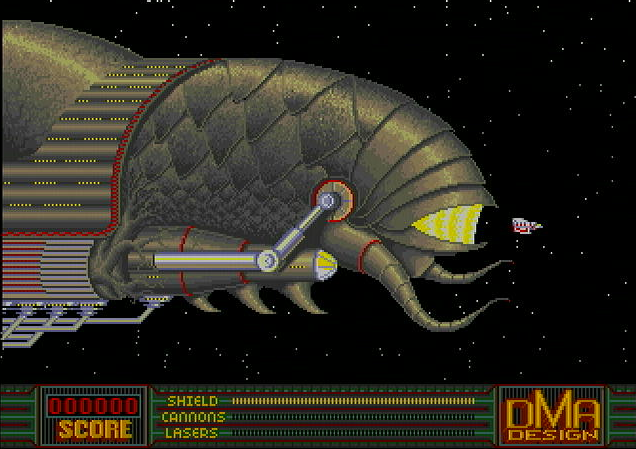
Six war criminal despot aliens, all exiled from their home planets, got together one day and decided to spend the next several centuries building an entire War Crime Planet out of chunks of other planets that they destroyed. These six draconian rulers would name this planet Draconia, because they are not very original, and the entire planet would be dedicated to being real spooky and evil and full of senseless violence. Only now that the planet is complete hundreds of years later after countless acts of genocide does anyone bother suggesting to maybe stop Draconia from doing this anymore. Maybe just send in one guy with a tiny ship with barely any weaponry however. Send them in with the Giant Space Slug from the Aldabran Galaxy. Hey, are slugs supposed to have fish scales?
 Menace is the debut title of the legendary DMA Design, the development team that started with this humble little shoot-em-up, but would go on to make acclaimed smash hits such as Lemmings and Grand Theft Auto and eventually become Rockstar North. Most Amiga shoot-em-ups are typically classified as ‘euro shooters’, referring to the difference in design philosophies between Western PC developers and Japanese arcade developers. We'll inevitably look at some euro shooters down the line, but the main common differences is that euro shooters tend to have health bars instead of one-hit kills, have a currency system that you use to buy upgrades and power-ups from a shop, are generally longer and slower-paced than Japanese shooters and also may or may not have some kind of inertia to your ship’s controls. I have issues with this categorisation, not least of which is the fact that many of the defining games classified as ‘euro shooters’ are actually American-made such as Tyrian and Raptor, and the term being ‘euro shooters’ seems to carry the same kind of dismissive “if it's not from Japan or America it's trash” energy that terminology like ‘eurojank’ carries, in spite of American developed games sharing much of the same design philosophies. Hell, even some Japanese developed games like Mr Heli incorporate euro shooter design philosophies, but I digress.
The reason this is relevant is because while Menace is European developed and does feature a health bar, it's overall much more influenced by Japanese arcade design philosophies, from its pacing to its controls to its power-ups, which generally take cues from Salamander and R-Type. Does Menace succeed at replicating that arcade shoot-em-up magic, in retrospect? Not particularly, but it’s not a bad effort for the time either.
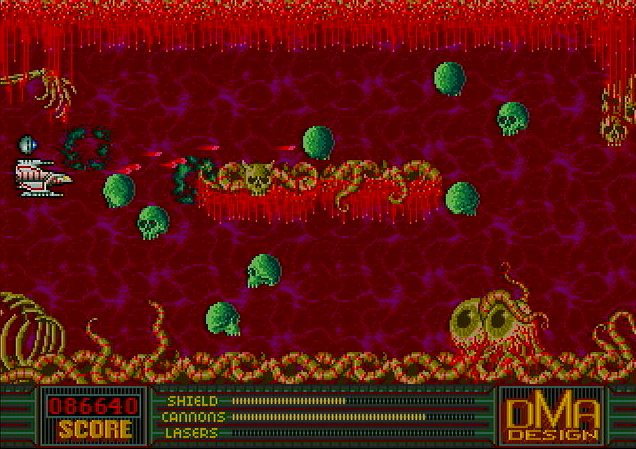
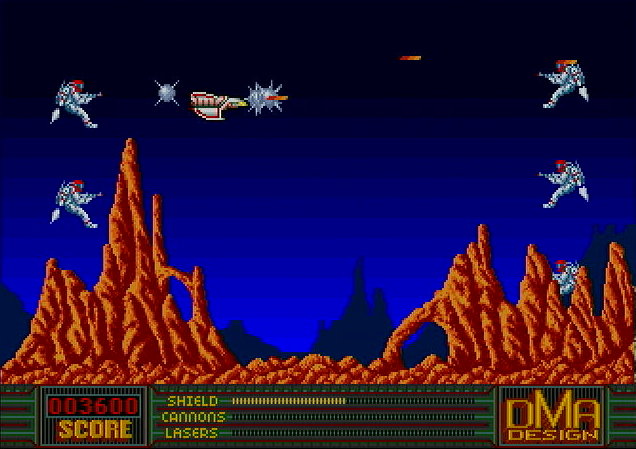
 Spanning six horizontally scrolling levels, you'll be blasting your way through waves upon waves of Draconia’s forces, collecting power-ups such as lasers, speed ups, shields and satellites to upgrade your ship with, and confront one of Draconia’s six war criminals at the end of each level in a boss fight. Classic Konami-style shooting action.
Much of Menace is admittedly derivative. Several of the level environments seem to be visually based off of R-Type, the ship you control appears to be based off of the Silver Hawk from Darius (most obvious when it's upgraded with cannons and lasers) and the aquatic theming of the giant space slug from the Alderbran galaxy (yes, that's actually what the manual calls it) could also be a potential Darius influence. The final boss meanwhile (click here to see the Menace final boss) is more or less copied from one of the bosses from Salamander, additionally including the fleshy walls closing in on you that were present throughout Salamander’s first level. According to DMA employee Mike Dailly, the game even used Salamander sound effects in development builds, captured from an arcade cabinet speaker with a tape recorder.
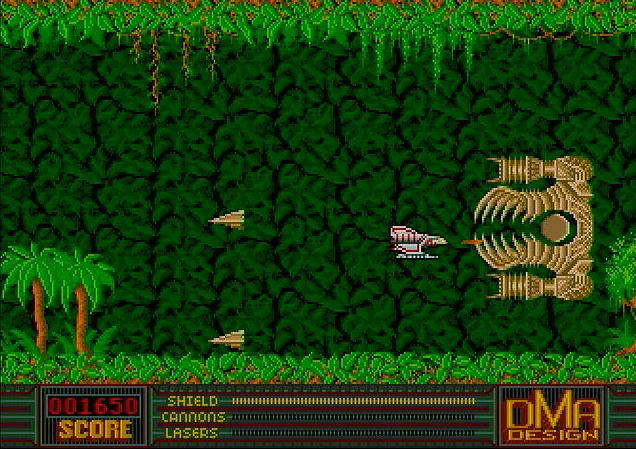 Honestly, I find this all kind of charming. It's clear that Menace was developed by a genuine fan of Japanese arcade shoot-em-ups, and that hunch is confirmed when you read the manual to Blood Money, Menace’s sequel, where the lead programmer on both games, Dave Jones, writes about his love of shoot-em-ups and his goal to develop the Amiga some shooters of arcade quality, as he considered that genre lacking on Amiga at the time. Menace’s derivative elements kind of have the vibe of someone experimenting with RPG Maker for the first time and learning how to add all of their favourite Final Fantasy characters into a test game, and the fact that I'm saying this about a game by the development team that would go on to become Rockstar North and make Red Dead Redemption 2 is absolutely adorable. Of course, people come and go from development teams, and when they have been around for as long as Rockstar it's rare for any of the original developers to still be with the company decades later. So, as for Dave Jones himself, he left Rockstar at the turn of the millennium, but not before being credited with the programming with Lemmings and Lemmings 2, as well as creative direction of Grand Theft Auto 2. Damn good legacy to leave behind.
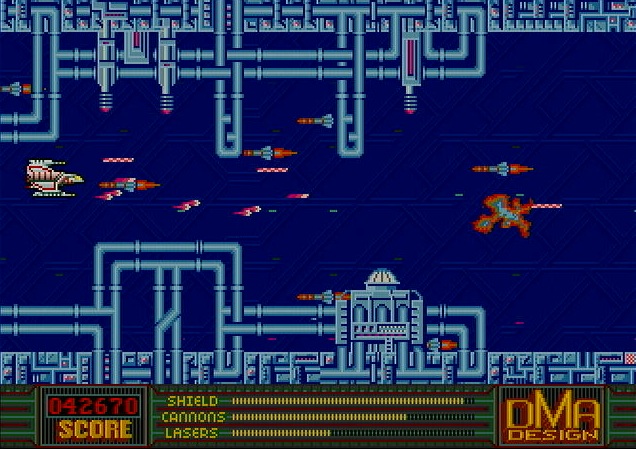
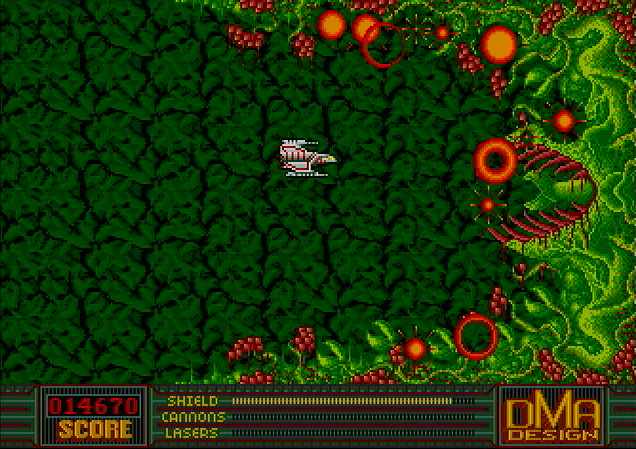
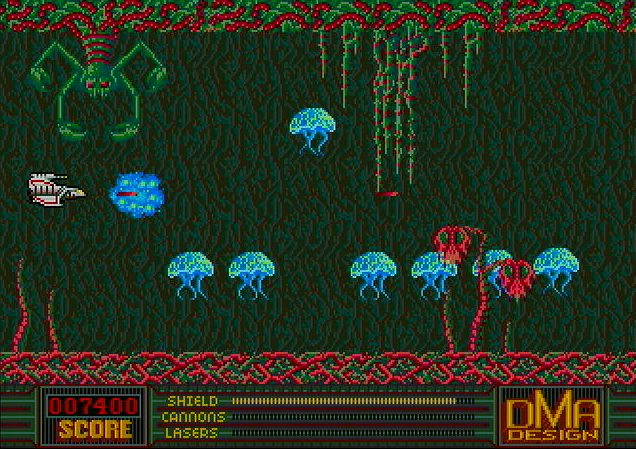
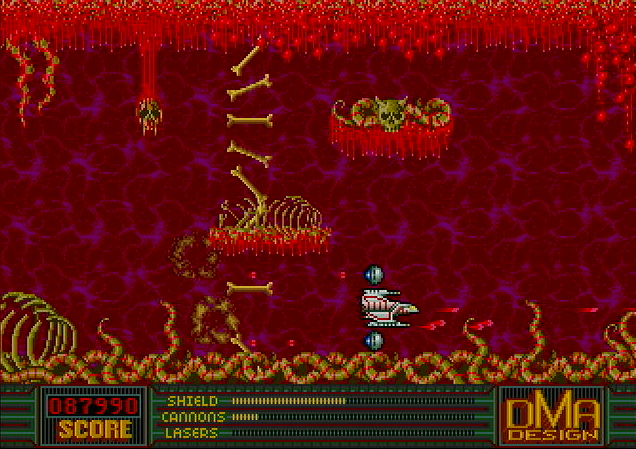
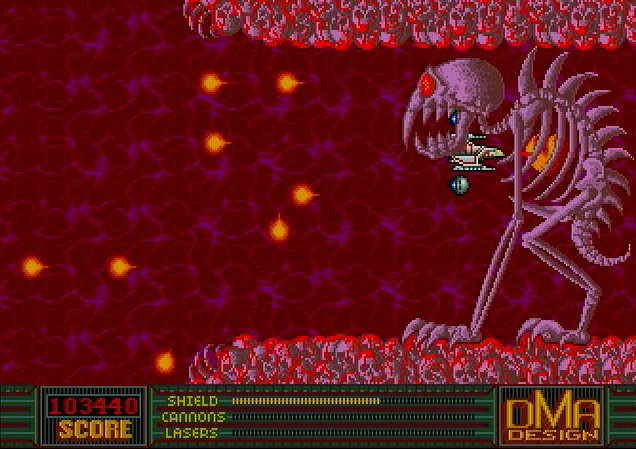
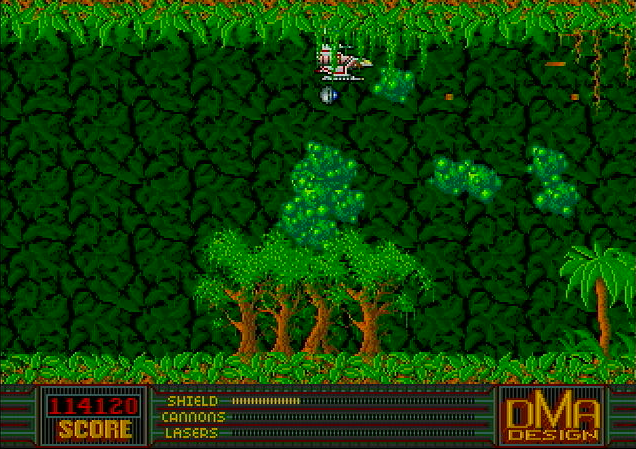
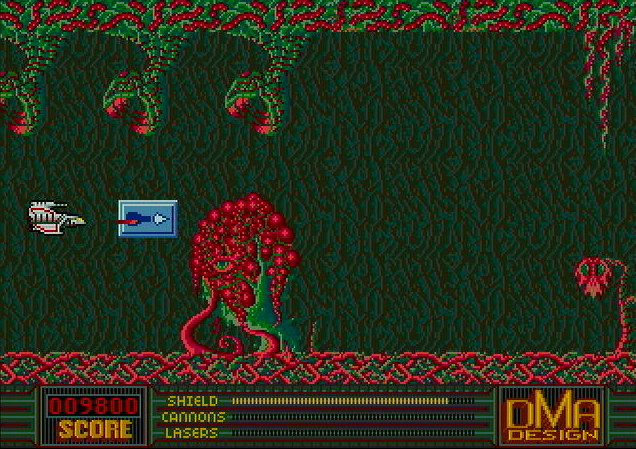 With all that said, the game does look pretty good and has some excellent pixel art throughout. Specifically, the levels that lean more into body horror like the Sea of Karnaug and Carnage Rift are a visual treat. Carnage Rift’s mess of dripping blood, bones and intertwined snakes was something I was already familiar with thanks to the Lemmings level based off of it, but the Sea of Karnaug also impressed with its strange alien fauna, such as the bizarre skeletal scorpion man, as well as the fleshy, bulbous and vaguely plant-like creature with an eye in the middle of it. I of course can’t be certain that these weren’t also copied from other games I’m less familiar with, but they look good. I seriously adore this kind of Giger-esque body horror biomechanical alien aesthetic that was so common in 80s and 90s video games. The game runs very smoothly too, no framerate drops or flicker getting in the way here.
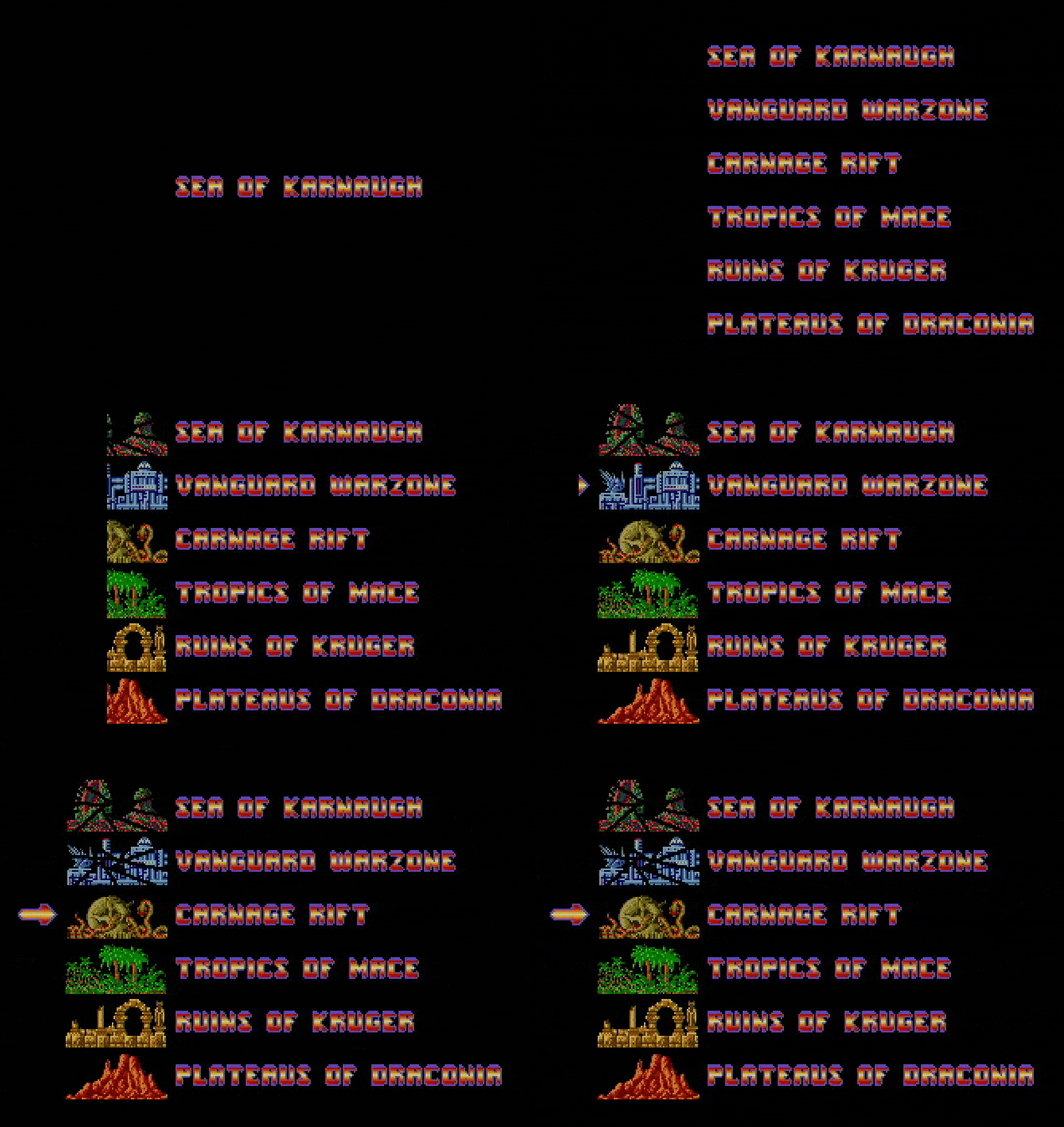
The sound is great too. The final non-Salamander sound effects done by David Whittaker are really punchy and satisfying, and although there’s only three music tracks in the game (title screen music, in-game music and boss fight music), the main in-game theme you’ll be hearing the most is that same banger track that was later used in the previously mentioned Lemmings level, which frankly is a track good enough that it doesn’t get old. I also adore the transition screen in between levels, showing a list of the stages throughout the game, followed by the preview of the stage you just cleared shattering with an impactful crack sound effect. Satisfying as hell.
Something that is (to my knowledge) unique in Menace is the way power-ups are acquired. If you destroy every single enemy in a wave without letting any pass you by, you will be rewarded with a 1,000 points pickup. However, if you continuously shoot it, the pickup will transform into a different power-up every time it takes five hits from your weapons. At five total hits the pickup will transform into a cannon power-up. Picking up one cannon simply attaches the cannon to the ship, so you need to pick up another cannon power-up in order to actually arm it with ammo. Shoot the pickup ten times and it will instead turn into the laser power-up, which behaves similarly in that you need to collect the weapon and then also collect the ammo. Shooting the pickup 15 times turns it into a speed-up power-up, which permanently increases your ship's maneuverability, making it much easier to shake off homing projectiles. At 20 hits your ship will get an outrider; a satellite that floats next to your ship and shoots in the opposite direction that you move your ship in. 25 hits gets you a force field, making your ship invulnerable for a limited amount of time. Finally, 30 hits will get you a full HP recovery, this being the only way to heal in the game.
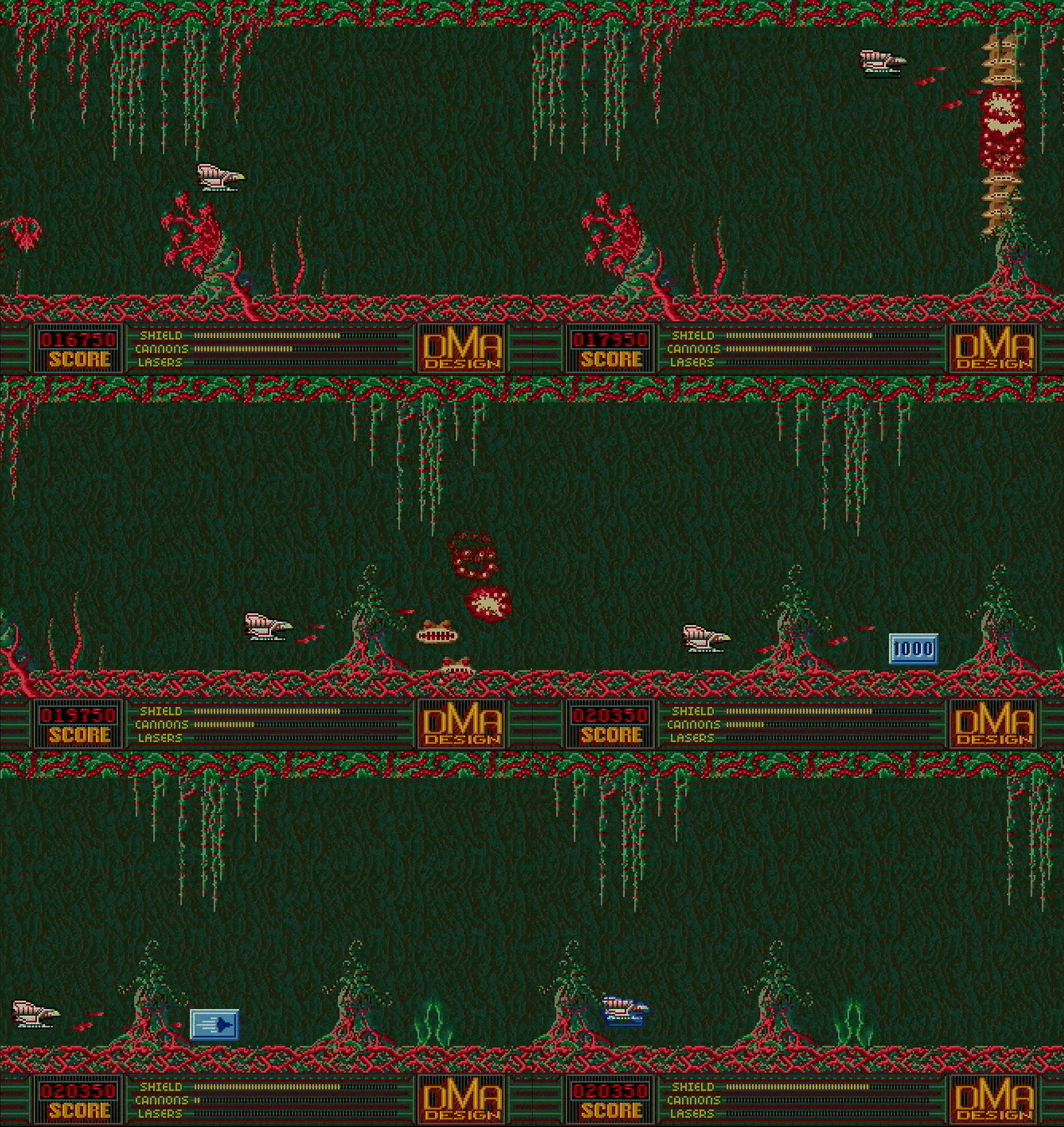
 This system is somewhat reminiscent of Twinbee, where the bells can also be cycled through different power-ups by repeatedly shooting them, however a difference with Twinbee is that those bells can be juggled indefinitely until the bell is a mangled mess, as each shot knocks the bell further up the screen. In Menace meanwhile, the pickups will move to the left at a consistent pace until they're off-screen, and there's nothing you can do to stop them. As a result, due to the pickup spawning where the last enemy in the attack wave died, killing the last enemy as close to the right side of the screen as possible will give you the most amount of time to shoot the pickup and get whatever specific power-ups you want. Having more power-ups that allow you to shoot more projectiles at once of course also helps by getting shots in much quicker.
It's honestly quite a well thought out system that manages to work in tandem with another unusual design choice of Menace; that being the fact that the ammo for the cannon and laser is finite. This sounds nasty, but as you can kill enemy waves much quicker and easier as you power up, that means that you have way more opportunities to get power-ups to keep your weapons stocked. Meanwhile, ammo conservation is rewarded, as if you don't need those ammo pickups, that firepower can instead be used to get more hits in on the pickup and more easily get the power-ups that require a lot of hits such as outliners, force field and full heal. Furthermore, the need for ammo ensures that going the extra mile to kill entire waves of enemies to get those power-ups is worthwhile throughout the entire game, because you can always use more ammo.
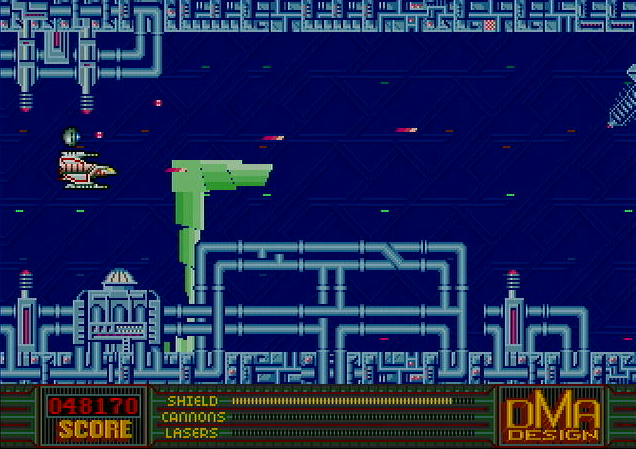
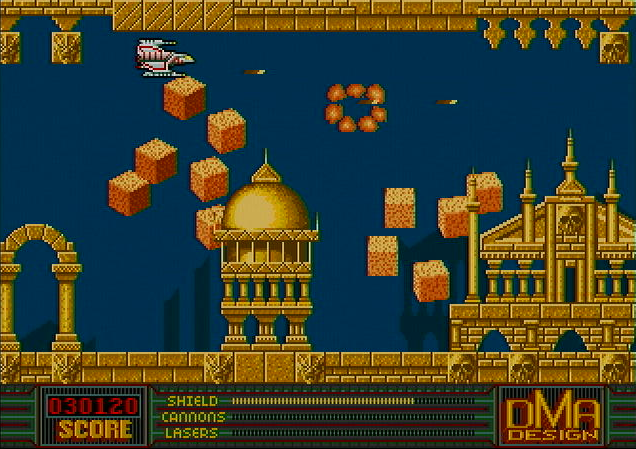 I just wish it wasn't so mash-heavy. Killing entire waves of enemies as well as getting the right power-up you want from a pickup requires extremely fast mashing of the fire button in order to hit everything before it goes off-screen. And no, there's no auto fire. I think I could comfortably one-credit clear Menace with a little practice, but the threat of RSI doesn't make it a super appealing proposition without a turbo controller.
Menace is also let down pretty severely by repetition. About two thirds of the way through any level, Menace runs out of new enemy waves to throw at you, and rather than taking that as the cue that it's time to end the level and have you fight the boss, the game instead just starts looping the enemy waves in the exact same order and the exact same formations, meaning that every level in the game ends with you replaying the first third of the level all over again with nothing different. This was almost certainly a padding technique, considering that even with this factor in play, Menace is still pretty short. But also, it's an arcade shoot-em-up, those are expected to be short. Part of the beauty of shoot-em-ups is just how little they are padded. They may be only 20-40 minutes long, if even that, but in that time you'll experience rapid-fire action so intense that other genres would instead opt to spread that content thinly across a 5 hour campaign. They're action games distilled to their purest form, and it's the depth, challenge and replay value that give them longevity. My point is, Menace doesn't gain anything from padding itself. It merely waters itself down and all it gets out of it is a few more minutes of runtime.
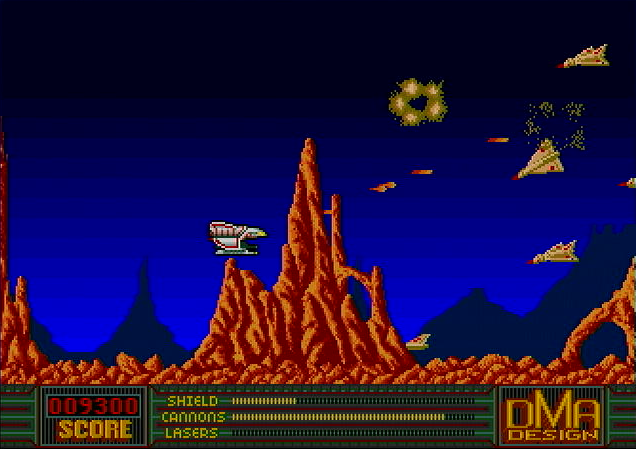
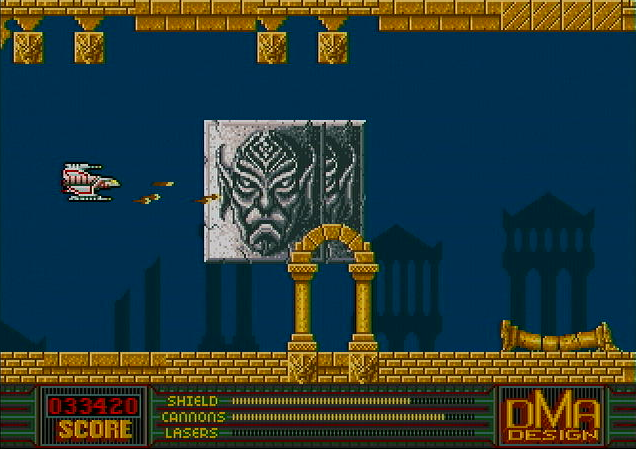 Menace is also surprisingly easy, and this may be the first arcade-style shoot-em-up I can say that about, as they're usually brutal. Yeah, if you run out of HP and die you lose all your power-ups and have to start the level over, but unlike Gradius or R-Type, it's much easier to recover in Menace. Case and point; I died on the final level, thus requiring me to restart the hardest stage in the game without any power-ups, but I was still able to beat the game pretty comfortably. You also have unlimited continues, so no stress there either. There is a harder difficulty option for a little extra challenge, which makes all of the environmental decorations throughout each level deal contact damage if you fly into them, and yeah that makes it harder, but it also makes it cheaper, as intentionally flying into such decorations and taking damage is often the only way to kill an entire wave of enemies before they fly off-screen. The game’s enemy formations just don't feel suited to expert mode in general, as they'll of course fly through and shoot through those decorations without taking damage. It’s not unplayable by any means; it just requires getting a hell of a lot more full heal power-ups.
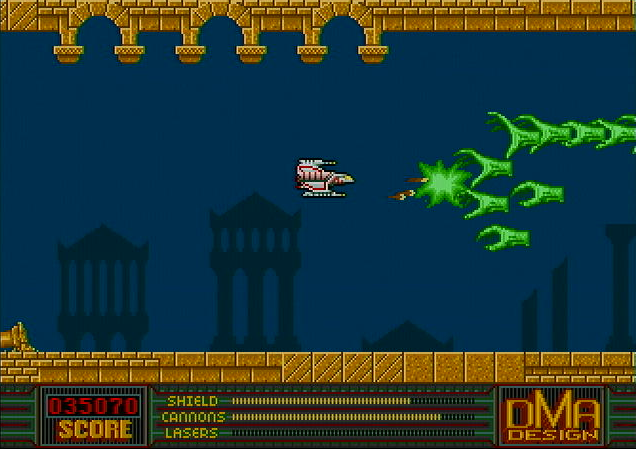 There's also the weird matter of how you only ever fight one type of enemy at a time. Each individual wave of enemies consists of duplicates of the exact same enemy and nothing else. The challenges that could be provided by combining more than one type of enemy are not explored, which really feels like a missed opportunity. I'd say the design here was more focused on having a large enemy roster over a well balanced one, as nearly every enemy shows up for their dedicated wave and then never again. That's not to say that there isn't still clear thought behind the formations of these waves, how their attack patterns will hinder the player and the strategies they'll need to use to survive them. Ironically though, in spite of the massive variety in enemies, they actually end up feeling more repetitive than something like Gradius. While the amount of different enemy types in Gradius 1 is small, the level design explores versatile implementations of those few enemies by combining them with other enemy types and incorporating them into the level terrain with some thought. By comparison, Menace throwing a wave of identical enemies at you, followed by another wave of identical enemies, over and over again, is far more predictable and repetitive. The bosses of Menace are also pretty weak unfortunately. If you have enough health left to tank some hits, just moving up right next to the boss’s weak point and mashing the fire button until it dies is enough to deal with every boss in the game quickly and efficiently. The damage that the bosses deal is nothing compared to your rapid-fire trigger finger you had to strengthen up to get those power-ups.
 With the low difficulty and repetitive enemy waves, Menace isn’t really as replayable as the masterfully designed classics it’s inspired by. I’ve one-credit cleared both R-Type and Salamander, and despite the two of them taking me about 20-30 hours each in order to achieve that, I had a great time with them, especially R-Type. The depth and strategy of those games, as well as the sheer variety in level designs and bosses, kept those games engaging and compelling even when replaying the same 6-8 levels over and over again to practice for that eventual perfect run. By comparison, I can’t really see myself being compelled to play Menace for the same amount of time. The power-up system is interesting, but that’s not enough to make up for the unexciting level design and repetitive enemy waves. It’s fine if you just want to beat the game once and then move onto something else since the game is still short enough for it to not have a chance to get too dull, but I feel like Amiga users purchasing Menace in the 1980s would probably be after something that could last them a bit more than a single evening.
Menace ain't bad. Not great, but ain’t bad. One of those “yeah, it's not going to win any awards but it's kinda fun for what it is” kind of games. Dave Jones’ enthusiasm for shoot-em-ups shows and for the most part he did an okay job of capturing the vibe of the arcade games he was inspired by and demonstrates an understanding of some of the design philosophies that make them engaging. With more of an original hook to the gameplay and power-ups, as well as some better variety in its level design and enemy patterns, I think we could have something great here. As it is, the game is okay. There's a lot here that could be improved and expanded upon in a sequel, but Menace’s sequel, Blood Money, is less of a step forward and more of a step sideways, being a very different style of shoot-em-up that does some things better and some things worse. We may eventually get to Blood Money if I ever manage to beat it. It is much harder than Menace. In the meantime, you can read Blood Money’s manual if you want more information on that game. It's really funny.
- Page written by MSX_POCKY, 9th January 2026