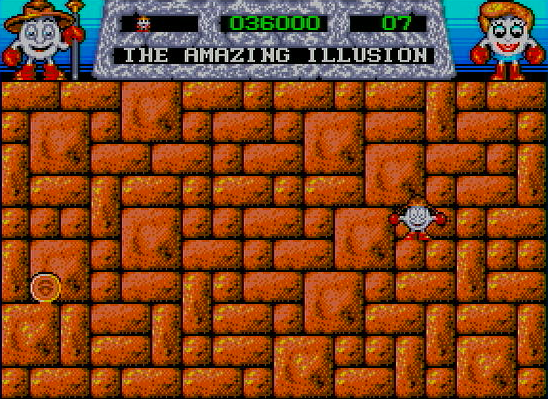
Fantasy World Dizzy – Codemasters - 1991 - First time playing?: No, played back in 2018
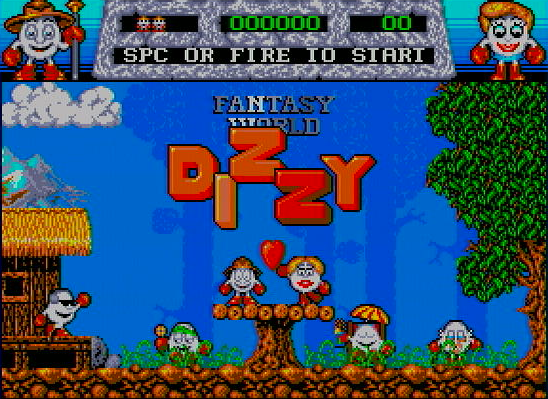
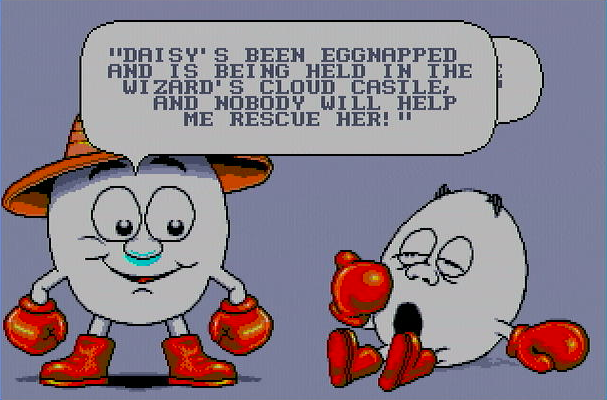
Dizzy is still an egg. This time his egg girlfriend has been eggnapped by an egg-hating wizard, while Dizzy himself has been thrown into a dungeon. This time, Dizzy will get minimal help from his egg friends that would rather do anything else but talk to Dizzy, but may be willing to give you a coil of rope or something.
 Treasure Island Dizzy was generally pretty miserable, but how about Fantasy World Dizzy? Eh, it's fine. I still don't feel particularly positively towards Dizzy, but this is absolutely a far better execution of the platformer/adventure game hybrid formula that the series is aiming for.
The general formula is roughly the same as Treasure Island Dizzy, so I recommend reading that game’s review if you want an outline on Dizzy’s formula. You explore a 2D platforming world, discover items, solve puzzles by using those items on whatever is impeding your current progress, repeat until victory. Dizzy also still somersaults in mid-air every time you jump, and as such will roll forward until he's back on his feet if he lands on a platform upside down.
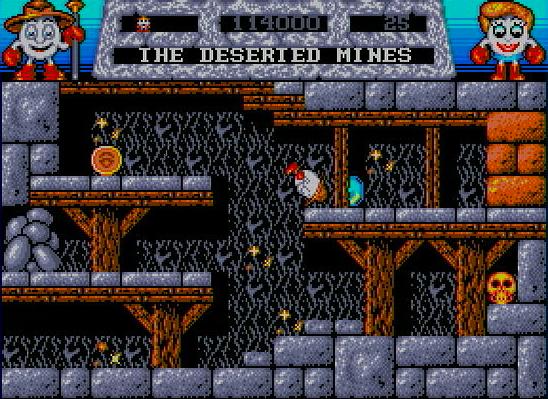
So, what’s different? Well, for starters, the game generally runs smoother, with Dizzy’s movement feeling a bit less jittery than it was in Treasure Island Dizzy. The game also has had quite the graphical upgrade, featuring far more detailed pixel art and sprites throughout. Your mileage may vary on whether everything looks better, as I could understand if you felt that Dizzy’s more detailed face diminishes the simplistic cuteness of his prior sprites, but overall I’d say it’s a much nicer looking game.
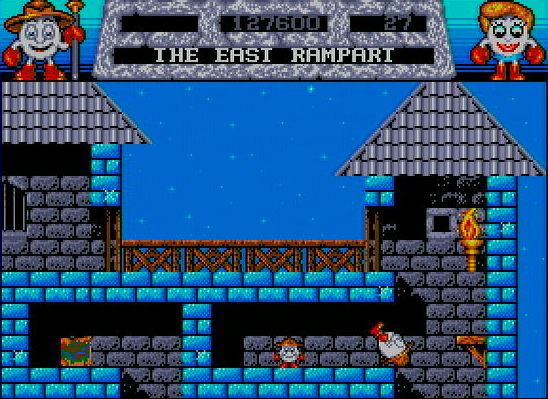
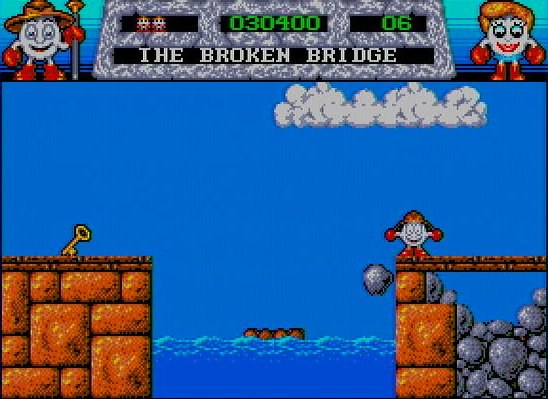 Dizzy still dies in one hit just like in Treasure Island Dizzy, but unlike that game, here you have extra lives, making things much less punishing. You start with three lives, but can get two more later on in the game for a total of five tries. Given that Fantasy World Dizzy is also quite a bit longer than Treasure Island Dizzy, and also often requires more precise jumps and timing, Fantasy World Dizzy would have been absolutely miserable to play without that room for error.
Another change is the inventory size. Okay, at the start of the game you can only hold two items at a time, which is even less than you could hold in Treasure Island Dizzy, but later on you can find inventory size upgrades that eventually allow you to carry five items at a time, at which point the inventory management ceases to be a problem. Frankly, I still would have much preferred if the game just started you with the maxed out inventory size. I don't really see what’s added by having to constantly backtrack to pick up items you didn't have inventory space for prior, other than padding of course. Still, if you know what you're doing, the only time you really need to backtrack before you get your inventory upgrades is a puzzle to the left of the dungeon where you need to raise the water level of a pool by tossing three rocks into it, which is somehow enough to displace the water a significant amount. Since you need three rocks and can only carry two at a time, this ensures that you'll have to go backtrack for one of the rocks. Still, that's one puzzle, whereas the entirety of Treasure Island Dizzy was built around that style of back and forth item juggling for the entire game.
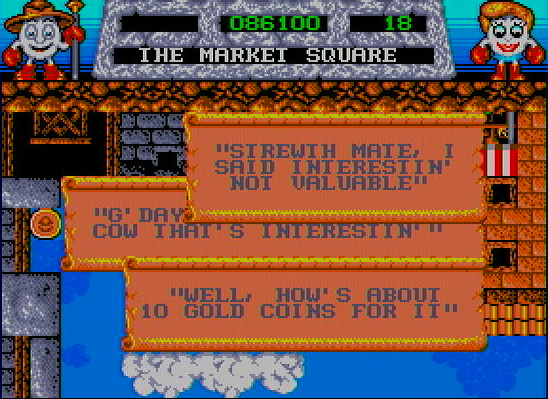
As mentioned in the intro, Dizzy is no longer the only egg in-game, which means that there's now a variety of NPCs for Dizzy to interact with. Don't get too excited by the expanded Egg Universe, because the other eggs are lame. They're characterised like smurfs in that they each have a personality that can be summed up in a single word. There's Cool Egg, Sleepy Egg, Hippie Egg and Old Egg. Cool Egg wears sunglasses and listens to music, Sleepy Egg sleeps, Hippie Egg gets high off of sniffing flowers and Old Egg tells rambling stories that no one cares about. The actual best character is the Australian. At one point Dizzy falls down a well that goes through the entire earth and has him end up in Australia, where you meet a magical teleporting Australian that you have to sell a very tiny cow to. This interaction manages to be absurd enough that it's actually pretty funny, and the fact that you actually trade with him means that you have more interaction with this random nameless Australian than any of the main character eggs who just drop an item and then refuse to talk to you.
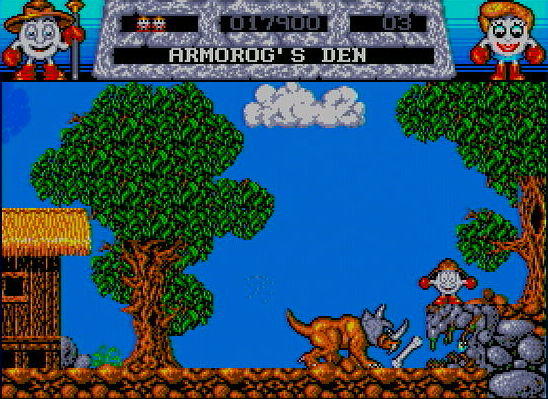
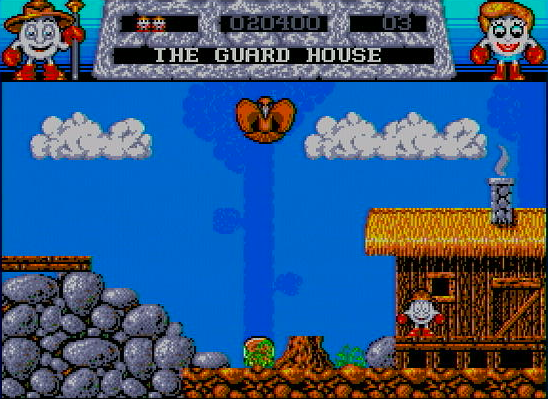
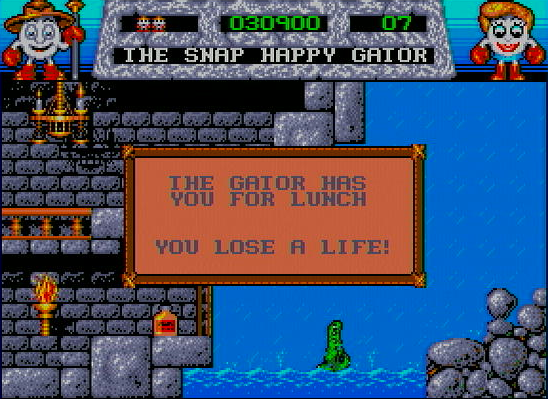
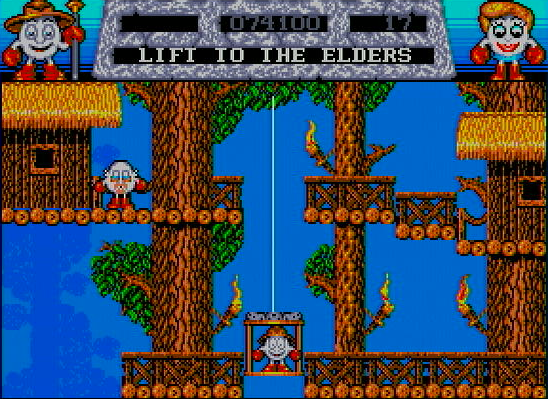 Fantasy World Dizzy is pretty tough for the first part of the game, but the difficulty curve of this game more or less goes in reverse. The starting dungeon you need to escape is by far the hardest part, requiring the most precise jumps, precise timing and also features the most amount of hazards. There’s a killer rat, some kind of armoured triceratops, an aggressive bird of prey, a snapping crocodile and a dragon, all in this intro alone. The second you're out of the dungeon, you've practically already won. The rest of the game is open and mostly hazard free, aside from some torches Dizzy can get fried on if you jump into, or the elevators that crush Dizzy if you step into them wrong. There’s not really enemies anymore, the same way there was in the first part of the game, although the dragon does show up again. As a result, the second half of the game ultimately is more of that gameplay loop of carrying items back and forward across an open map that Treasure Island Dizzy devolved into, but it's not nearly as bad here. Getting across the map is less tedious in Fantasy World as you don't have to constantly wait for slow moving enemies to get out of your way, nor do you need to constantly shuffle the order of your inventory items to keep the snorkel in the bottom slot. It's still not particularly exciting, and the game definitely feels like it has run out of steam by the second half, but it's better than what came before.
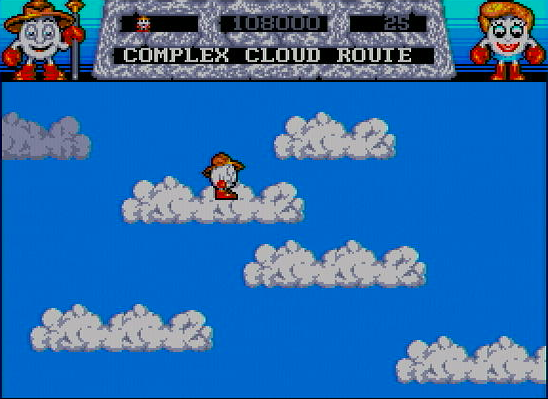
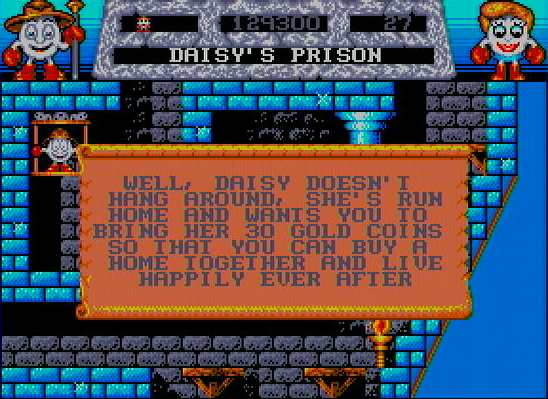
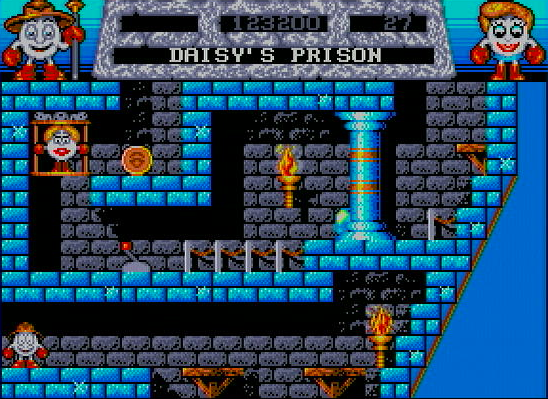 The game does also pull the same move that Treasure Island Dizzy did when you seemingly ‘beat’ the game by achieving the objective outlined in the game’s manual, where it turns out you're not done yet and can't finish the game until you collect all 30 coins. In this game’s case, Dizzy’s girlfriend decides to engage in some financial domination and will not let Dizzy rest until he buys a new house for her. Yes, really. You can get most of these coins as you progress through the game, even if some of them are obnoxiously well hidden such as the coin hidden in a clump of leaves on a tree branch that you can only reach by pressing the action button while standing on the very edge of a slightly raised bit of land. Personally, I'm more annoyed by the coin that's hidden in the very first room of the game. To get this coin, you first need to give the troll in this starting room an apple. He won't do anything except give you a hint on the most complex puzzle in the game; pouring water on a fire. As such, giving the troll the apple may seem pointless on replays, but it's actually vitally important, as feeding the troll results in the troll getting fired for helping Dizzy, and then the troll retreats to hide in a cave near the end of the game. Then, if you talk to the troll in this cave, he will also do nothing other than blame you for him losing his job and tell you to go away, but now, if you go back to the starting room after talking to the troll on the other side of the map, there will now be a coin there. Two unrelated actions making a coin spawn at the very start of the game when you’re at the very end of the game? Yeah, sure, whatever, Dizzy.
 When you get right down to it, a lot of inventory puzzle focused adventure games of the era, from LucasArts or Sierra, can be boiled down to a lot of back and forth and carrying items from one place to another. As Dizzy is more or less an adventure game in that style, the amount of backtracking is hardly surprising. Judging adventure games by such traditional gameplay mechanics is generally going to paint a dull picture of that game, but that's not the appeal. You play an adventure game to instead get the satisfaction of piecing together a large puzzle while immersing yourself in the world building, narrative and characters. Dizzy’s story and characters are uninteresting and the dialogue is poorly written, so it doesn't really have that plus, and the puzzles meanwhile are generally overly simplistic. It's the combination of those adventure game elements with Commodore 64 style platforming gameplay that makes the games interesting.
But while the combination of genres is interesting, does it actually work? Ultimately, I think that Dizzy being an arcade-style game that you can lose by mistiming a jump in and end up losing all progress in is actually part of why its adventure game elements grate me. Even in adventure games where you can die, you still typically only have to do each fetch quest once, assuming that you remembered to save. Even if you lock yourself into an unwinnable situation and have to start the whole game over, as miserable as that is, there's still something new there as you now have to reconsider how and where you use your items and what could be used as a substitute in certain earlier puzzle solutions. In Dizzy meanwhile, getting a game over results in you having to do all the same tedious item fetch quests all over again, but without any of the satisfaction of figuring them out for the first time. You did the puzzle solving just fine and there’s nothing to improve upon or refine there other than maybe better inventory management. The only reason you’re doing this again is because you failed to jump over a sleeping dinosaur with pixel precision.
 Fantasy World Dizzy is a lot more linear than Treasure Island Dizzy, and that honestly might actually be a knock against it. When you die and have to start over in Treasure Island Dizzy, you can try doing things in different orders to freshen up repeat attempts at beating the game, whereas failure in Fantasy World Dizzy means doing the same sequence of puzzles in the same order all over again. Though, again, the much lower difficulty of Fantasy World Dizzy reduces the amount of restarts, so it does end up ultimately less of an issue. I do think it makes the end-game unnecessarily high-stakes and stressful however, but maybe that’s intentional, keeping the player on the edge of their seat while doing something as mundane as a scavenger hunt for the last few coins you need to win the game?
Ultimately, Fantasy World Dizzy is inoffensive. Its biggest crime is just being a bit dull. The Dizzy series seems to have a bit of a ‘love it or hate it’ kind of reception, and while my girlfriend is firmly a Dizzy hater that will never stop bullying this egg for as long as it keeps being funny, I’m a little more mixed. I don’t particularly like the games, but I at least find them somewhat interesting to analyse, partially due to finding the combination of genres interesting. I do think it’s possible for this combination to work. It’s a much later game, but Psychonauts more or less achieves this blend of platforming and adventure game puzzles in a really satisfying and engaging way, albeit in 3D rather than 2D. Dizzy first attempting this genre mashup on the ZX Spectrum, a system where it’s considered a luxury for your platforming protagonist to even have some kind of basic attack to defend themselves with, is certainly ambitious if nothing else, and I can see how that would be enough to attract a dedicated fandom of people who gel with that combination. As for me? I’m pretty lukewarm. The game is fine, more or less.
- Page written by MSX_POCKY, 15th January 2026